
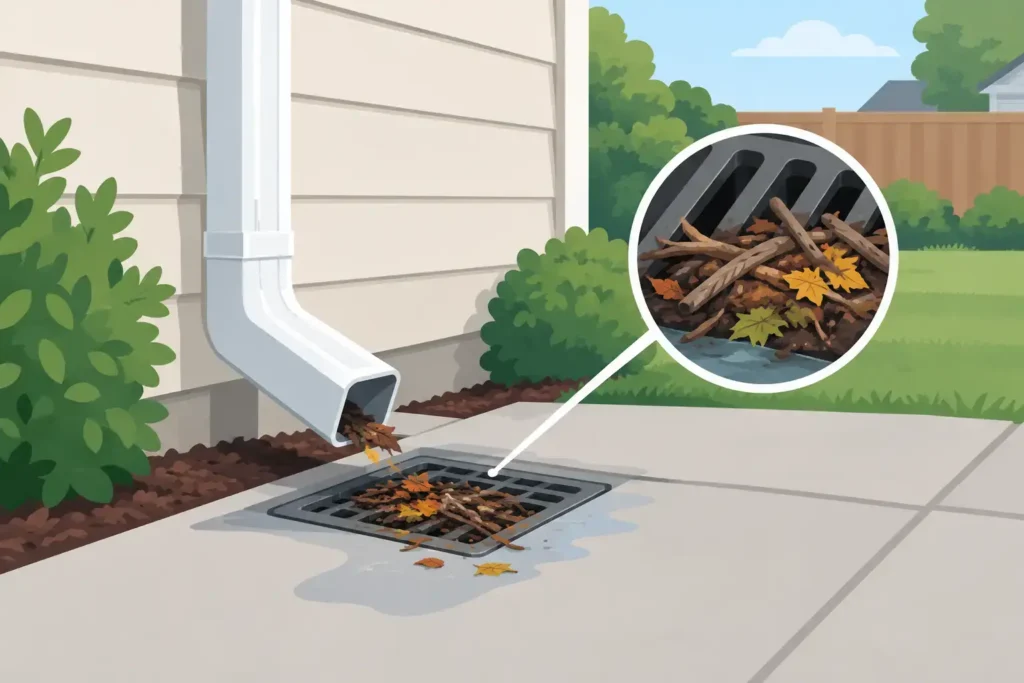
A drain that fills again a few weeks after clearing is rarely just bad luck. If you are asking, why does my outside drain keep blocking, the answer is usually a repeated source of debris, a drainage run that is not flowing as it should, or both. Acting early helps protect paths, patios, driveways and the areas around your property from standing water, smells and slippery growth.
Why does my outside drain keep blocking?
Outside drains handle far more than rainwater. They collect what washes from roofs, gutters, driveways, patios and garden areas, often carrying material that is easy to miss until water starts backing up. London properties can be especially prone to this in autumn and winter, when leaves, moss and surface dirt are regularly moved by heavy rain.
The most common causes are leaves and garden debris, moss washed from roofs or paving, compacted silt, cooking fats entering a gully, and broken or displaced pipework below ground. The location of the blockage matters. A blockage sitting just beneath the grate can sometimes be removed safely; one further down the line may need professional equipment and investigation.
Leaves, moss and organic debris
A gully beside a patio, driveway or downpipe is a natural collection point for leaves, twigs, soil and loose gravel. Roof moss is another frequent culprit. When rain carries it through gutters and downpipes, it can settle in the gully trap and form a dense, sponge-like mass. Add silt and wet leaves, and the water channel narrows quickly.
This is why a drain may appear fine through summer but overflow after the first sustained autumn rain. Clearing the visible material helps, but it will block again if gutters are overflowing, surrounding paving is shedding debris, or nearby trees continually feed the same drain.
Silt, mud and driveway wash-off
Silt is finer than leaves and can be more persistent. It builds gradually at the bottom of gullies, particularly around driveways, gardens and older paved areas. Pressure washing can also move existing dirt towards drainage points if the work is not planned carefully and the gullies are not cleared afterwards.
A small amount of sediment is normal. The concern is when the gully trap becomes so full that water has only a narrow route past it. Surface water then drains slowly, bringing more dirt with it each time it rains.
Fats, detergents and inappropriate waste
External gullies connected to kitchen waste pipes can block when fats, oils and food residue cool and harden inside the pipe. Even if the visible grate is outside, the source may be what is going down sinks indoors. Strong cleaning products can also cause problems when mixed with grease and debris, rather than solving them.
Rainwater drains are different. They should not receive paint, cement washings, pet waste, food scraps or cleaning slurry. These materials can set, settle or create a blockage that routine clearing cannot shift.
Roots, damaged pipes and poor falls
If an outside drain keeps blocking despite regular removal of debris, the issue may be underground. Tree roots can enter small gaps in older pipe joints and expand inside the line. Cracked pipes, displaced sections and a poor pipe fall can all slow the flow, allowing waste to catch and build up in the same place.
This is an important trade-off: repeated surface clearing may restore drainage temporarily, but it will not correct a damaged run. Signs such as one gully repeatedly backing up, water appearing from a different drain, or a persistent foul smell after clearing are good reasons to have the system assessed.
Signs your outside drain needs attention now
Do not wait until water reaches the doorstep. A drain normally gives warning signs before it fully blocks. Watch for slow-draining water after rain, puddles that remain long after the weather has cleared, gurgling from a gully, unpleasant odours, or dark staining around the drain cover.
You may also notice algae or slime forming on paving where water regularly sits. This is not only untidy. Wet surfaces can become slippery, particularly on shaded patios, entrance paths and driveways.
If wastewater is overflowing, the cover cannot be lifted safely, or you suspect a deeper obstruction, avoid adding more water or chemical drain cleaner. Keep children and pets away from the area and arrange professional help promptly.
What you can safely check before calling for help
Start with the simplest inspection. Put on gloves, remove the drain grate if it lifts easily, and clear loose leaves, litter and surface debris by hand. A small bucket of clean water can then show whether the drain is flowing freely or sitting high in the trap.
Check the nearest gutter outlet and downpipe too. If water is spilling over the gutter or the downpipe shoe is packed with moss, the gully below is likely receiving more debris than it can handle. Clearing both areas is more effective than treating the drain alone.
Avoid forcing rods into a drain if you do not know the pipe layout, and do not mix chemical products. Harsh chemicals can be hazardous, may damage some pipework and are unlikely to solve compacted silt, roots or a structural fault. Likewise, a domestic pressure washer can push debris further into a pipe if used without the correct drain-cleaning attachment and experience.
How to stop an outside drain blocking again
Prevention works best when it deals with the source of debris as well as the gully itself. For most homes, a quick seasonal check before autumn and after periods of heavy leaf fall makes a noticeable difference. Keep grates clear, sweep loose material away from drainage points and remove soil build-up from the edges of patios and driveways before rain carries it into the drain.
Gutter maintenance is closely linked to drainage performance. If gutters are full of moss, leaves or roof debris, every downpour can send that material directly to the gully. A proper gutter clear, followed by sensible roof and surface maintenance, reduces the cycle of repeated blockages.
For patios and driveways, cleaning should be surface-specific rather than overly aggressive. The aim is to remove algae, grime and loose debris while managing runoff carefully. On suitable surfaces, controlled pressure washing and post-clean drainage checks help leave the area clean without depositing wash-off into the drainage line. Where moss and biological growth are the main issue, a suitable soft-wash treatment can reduce regrowth without relying on force alone.
It also helps to know which drain serves what. A rainwater gully, a kitchen waste gully and a driveway channel should be treated differently. Keeping a simple note of which drains tend to fill first can make recurring faults much easier to identify.
When professional drain unblocking is the sensible option
A professional call-out is worthwhile when a blockage returns quickly, water is overflowing, or there is no obvious debris at the surface. The right approach starts with assessing the gully, surrounding runoff and likely pipe route, rather than simply blasting water into the opening.
For property owners in Wembley, Harrow and surrounding North London areas, Crown Clean London can provide exterior drain unblocking alongside gutter clearing and exterior cleaning. Sending clear photos and your postcode is a practical first step: it helps establish whether the problem looks like a surface blockage, accumulated debris from gutters, or something that may need closer investigation on site.
A tidy completion matters here. The work should not simply get water moving for the moment; the grate, gully area and immediate surface should be left clear, with the likely cause explained so you know what to monitor next.
A free-flowing outside drain is easy to overlook, but it protects the surfaces you have invested in and keeps everyday access safer. If the same drain is blocking repeatedly, treat it as useful evidence: find what is feeding it, clear the route properly, and deal with the underlying issue before the next heavy spell of rain.