Moss can make a roof look tired long before it becomes a serious maintenance issue. But knowing how to remove moss from roof tiles safely matters far more than simply getting a greener roof clean. The wrong method can crack ageing tiles, strip protective finishes, dislodge mortar or force water beneath the covering – turning a cleaning job into an avoidable repair.
For most London properties, the safest approach is gradual: assess the roof, remove heavy growth carefully, clear the debris, then apply a suitable treatment to deal with spores left behind. It is not a job to rush from a ladder with a pressure washer.
Why moss needs careful removal
Moss holds moisture against roof tiles and gathers in overlaps, valleys and around chimney details. Over time, this can keep sections of the roof damp for longer after rain. During colder weather, trapped moisture may also contribute to frost damage on vulnerable or already weathered tiles.
There is another practical problem: loose moss travels. Rain washes it into gutters, downpipes and gullies, where it can contribute to blockages. A roof may look cleaner after a quick scrape, yet still cause trouble if the guttering below has been left full of debris.
That does not mean every patch of moss requires immediate action. Light growth on sound tiles can often be monitored and treated at an appropriate time. Thick, established moss, moss lifting at tile edges, or repeated gutter blockages are stronger signs that it is time for a proper clean.
Start with a roof condition check
Before any moss is removed, check whether the roof is suitable for cleaning. From ground level, look for slipped, cracked or missing tiles; damaged ridge mortar; exposed underlay; sagging areas; and blocked gutters. Binoculars or clear photographs are often safer and more useful than climbing up for a closer look.
A close inspection should also identify the roof material. Concrete tiles, clay tiles, slate and fibre-cement products can all need different levels of care. Older clay tiles and natural slate, for example, may be particularly vulnerable to aggressive cleaning. If there is any doubt about the roof’s condition or material, stop before cleaning and seek specialist advice.
Avoid walking directly on roof tiles unless you are trained, properly equipped and know where the roof structure can safely take weight. Tiles can break underfoot, and a fall from even a modest height can have serious consequences. Safe access is part of the job, not an optional extra.
How to remove moss from roof tiles safely
The safest cleaning method usually combines controlled manual removal with a low-pressure treatment. Heavy moss is removed first so that it does not clog the gutters or leave large piles of wet debris on the roof. A professional will normally work methodically from the ridge downwards, using tools designed to lift growth without gouging the tile surface.
The direction matters. Moss should be eased down the roof rather than pushed upwards beneath tile laps, where it can disturb the overlap and potentially direct debris under the covering. The work must be slow enough to avoid levering against brittle edges or pulling at loose mortar.
Once the bulk of the moss has been removed, the roof and surrounding areas need a thorough clear-up. This includes gutters, valleys, downpipes and any ground-level drainage points affected by the debris. Leaving moss in a gutter simply moves the issue from one part of the property to another.
A suitable biocide or soft-wash treatment can then be applied at the correct dilution. This tackles the remaining moss spores, algae and lichen that manual scraping cannot fully remove. The treatment generally continues to work over time, with weather gradually carrying away dead organic growth. Results can improve over the following weeks and months rather than appearing as an instant bright-white finish.
Why high-pressure washing is often the wrong choice
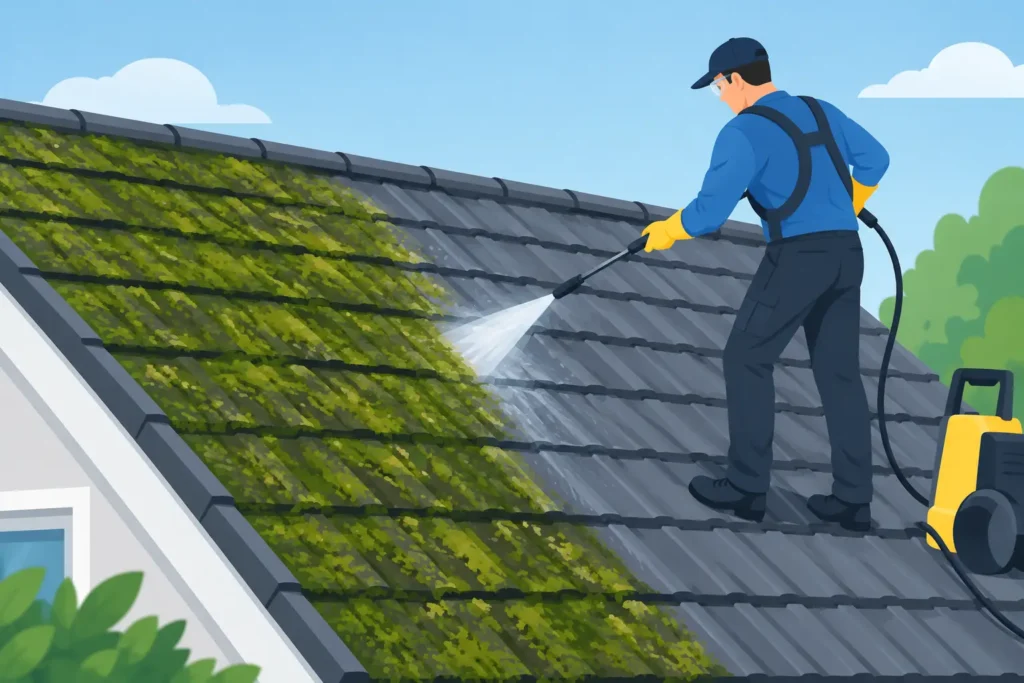
Pressure washing can produce dramatic immediate results, but it is not automatically safe for a tiled roof. Strong water pressure may erode the tile surface, dislodge granular coatings on some concrete tiles, drive water into the roof space and disturb pointing or flashings. It can also leave a roof looking clean while spores remain ready to regrow.
There are limited situations where carefully controlled low-pressure rinsing may be appropriate, depending on the tile type, condition and roof design. However, a one-method approach is not good roof care. Surface-specific cleaning is safer than treating every roof like a driveway or patio.
Choose the right weather and preparation
Dry, calm conditions are best for manual moss removal and treatment. Wind makes ladder work and chemical application harder to control, while rain can dilute a treatment before it has had time to work. Very hot days are not always ideal either, as products can dry too quickly on the tile surface.
Protect the area below before work begins. Move garden furniture, cover delicate plants where appropriate, and ensure vehicles are clear of the working area. Moss and dirty water can fall during the clean, even with careful collection methods.
It is also sensible to let neighbours know if access, falling debris or overspray could affect a shared boundary. Good preparation keeps the job tidy and reduces the chance of an otherwise straightforward clean becoming disruptive.
Do not use these shortcuts
Householders are often tempted by quick fixes, especially when moss is visible from the street. These methods can create more work and expense than they save:
- Using a domestic pressure washer from a ladder or across the roof surface.
- Applying bleach, strong acids or household cleaners not intended for roof materials.
- Scraping with sharp metal tools that can score, chip or loosen tiles.
- Leaving removed moss in gutters, valleys or at the base of downpipes.
- Cleaning without checking for broken tiles, unstable ridges or unsafe access first.
Chemical treatments should always be selected for the specific surface and used in line with the manufacturer’s instructions. More product is not necessarily better. A controlled application protects the roof, nearby planting and drainage systems.
When professional roof moss removal is the safer option
Professional help is particularly worthwhile for steep roofs, properties with more than one storey, older tiles, extensive moss growth or roofs with difficult access. It is also a sensible choice where guttering is already overflowing, where there are signs of damage, or where the property has solar panels, conservatories or landscaped areas that need protecting during the work.
A careful contractor should explain the proposed method before starting. Ask whether they use manual moss removal, soft washing or a biocide treatment; how gutters will be cleared; and how they will protect the surrounding property. Clear answers are a good sign that the work has been assessed rather than priced as a generic wash-down.
At Crown Clean London, roof moss removal is approached as a surface-care job, not simply a pressure-washing job. A photo and postcode can help establish the roof type, likely access requirements and the most suitable treatment before a booking is arranged.
Help the roof stay cleaner for longer
No roof stays completely free of organic growth forever, particularly in shaded streets, beneath overhanging trees or on north-facing slopes. The aim is to slow regrowth and keep moisture and debris from building up.
Keep gutters and valleys clear, trim back branches where practical, and check the roof visually after autumn leaf fall and severe weather. A follow-up biocide treatment may be appropriate after the initial clean, but the timing depends on exposure, tile type and how quickly moss returns.
A clean roof should still look like a roof – not newly painted or unnaturally stripped. The best result is a cleaner, sharper-looking surface with its tiles intact, gutters flowing and the property left tidy below. If access is uncertain or the roof shows signs of age, choosing a careful, assessed treatment is the safest way to protect both the appearance and condition of the home.