London brickwork can collect decades of dirt, soot, traffic grime, algae and other contamination, but cleaning a brick wall is not as simple as pointing the strongest available pressure washer at it.
The safest brick cleaning method depends on the brick, mortar, age, condition and type of staining. Sound modern brickwork may tolerate controlled water cleaning in suitable circumstances, while older, handmade, weathered or lime-mortared brickwork can require a significantly gentler approach.
This guide compares common brick cleaning methods, including pressure washing, hot-water or specialist steam-based cleaning and gentler manual techniques, so you can understand why the surface should be assessed before cleaning begins.
Why Does the Brick Cleaning Method Matter?
Brick has a reputation for being a robust building material, but brickwork is a system made up of both bricks and mortar. Individual bricks also differ considerably in hardness, texture, porosity and age.
The Brick Development Association advises that identifying both the cause of staining and the material being cleaned is essential before selecting a cleaning technique.
You can read its detailed Cleaning of Clay Brickwork guide.
Before cleaning exterior brickwork, consider:
- The age of the brickwork
- The type and condition of the bricks
- The type and condition of the mortar
- Whether the wall contains previous repairs
- The cause of the staining
- Whether bricks are soft, handmade or heavily textured
- Whether there is existing spalling or surface deterioration
- Whether the building has historic or heritage significance
Crown Clean London provides professional brickwork cleaning in London, with the cleaning approach considered according to the surface rather than assuming every wall needs identical treatment.
What Causes Exterior Brickwork to Become Dirty?
Different contaminants can require different treatments, which is why identifying what is actually on the brickwork matters.
Exterior brick walls may be affected by:
- General atmospheric dirt and grime
- Traffic pollution
- Soot and smoke deposits
- Algae and other organic growth
- Moss in persistently damp areas
- Efflorescence and salt deposits
- Lime staining
- Cement or mortar residue
- Oil and grease
- Paint or graffiti
A method that works for ordinary atmospheric grime may be completely inappropriate for a chemical stain, salt deposit or deteriorating brick face.
What Is the Gentlest Way to Clean Brickwork?
For ordinary dirt and grime, relatively gentle cleaning is often a sensible starting point.
The Brick Development Association recommends beginning established dirt, grime and soot cleaning with a stiff nylon brush and detergent solution. Its broader cleaning guidance also identifies hot water, detergent and a bristle brush as a common water-cleaning approach.
A basic sequence may therefore involve:
- Identifying the brick and mortar condition.
- Determining what type of contamination is present.
- Testing an inconspicuous area.
- Beginning with a relatively gentle approved method.
- Assessing the result before increasing cleaning intensity.
This principle is useful for many exterior surfaces: use the least aggressive method capable of achieving an acceptable result.
Can You Pressure Wash Brick?
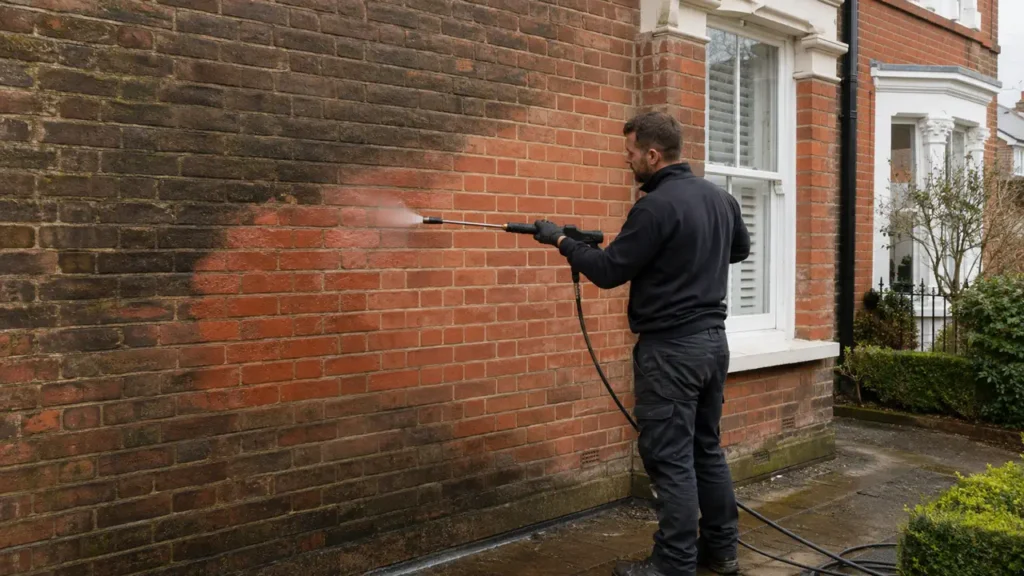
Pressure washing can be used on some suitable brickwork, but it should not be treated as universally safe.
The condition of both the brick face and mortar should be assessed first.
Possible risks of excessive pressure include:
- Damaging the face of softer bricks
- Breaking heavily textured brick surfaces
- Eroding mortar joints
- Removing material from sand-faced bricks
- Driving excessive moisture into masonry
- Making existing deterioration worse
- Creating an uneven appearance
The Brick Development Association specifically warns that pressure washing older brickwork should not be undertaken without a detailed survey of its condition.
Historic England also warns that overzealous high-pressure water cleaning can roughen masonry surfaces and cause significant damage.
You can read Historic England’s guidance on cleaning biological growth from masonry.
When Might Controlled Pressure Washing Be Suitable?
Controlled pressure cleaning may be an option where brickwork is sound, the mortar is appropriate and the contamination responds to water cleaning.
Even then, the process should not begin at maximum pressure.
The Brick Development Association recommends several precautions where a pressure washer is considered appropriate, including:
- Using a fan-type spray
- Beginning at low pressure
- Testing an inconspicuous area first
- Avoiding placing the nozzle unnecessarily close to the wall
- Maintaining a consistent working distance
- Considering the condition of mortar before cleaning
Crown Clean also provides professional pressure washing in London for exterior surfaces where controlled pressure cleaning is appropriate.
Should Old Brickwork Be Pressure Washed?
Old brickwork requires significantly more caution.
Age alone does not determine whether a wall can be cleaned, but older buildings are more likely to contain materials and previous repairs that respond poorly to aggressive cleaning.
For example, older brickwork may contain:
- Soft handmade bricks
- Weathered brick faces
- Lime mortar
- Historic repairs
- Different bricks from several periods
- Areas of previous inappropriate cleaning
The Brick Development Association specifically advises against pressure washers on lime mortar and warns that high-pressure jets can erode mortar joints.
If you own an older London property, particularly a period property, the objective should be to clean the masonry without unnecessarily removing original material.
What About Victorian and Period Brickwork in London?
London contains a large amount of Victorian, Edwardian and other period brickwork. These buildings can look robust while still containing relatively vulnerable historic materials.
A period wall should therefore be assessed for:
- Original brick type
- Mortar condition
- Previous repointing
- Spalled brick faces
- Cracks or movement
- Previous coatings
- Different repair materials
If brick faces are already deteriorating or mortar can be easily displaced, aggressive cleaning is unlikely to be a sensible first option.
Can Steam Cleaning Be Used on Brickwork?
Specialist hot-water, superheated-water and steam-based systems are used within the wider masonry-cleaning industry, but the terminology can be confusing because these methods are not all identical.
They differ in:
- Temperature
- Water volume
- Working pressure
- Nozzle design
- Distance from the surface
- The type of contamination being removed
The potential advantage of a controlled hot-water or specialist steam-based method is that heat can help loosen some contamination without relying purely on extremely high mechanical pressure.
However, that does not mean steam is automatically appropriate for every brick wall.
The brick, mortar, contamination and condition should still determine whether a particular system is suitable, and a test area remains important.
Is Steam Cleaning Always Gentler Than Pressure Washing?
Not necessarily.
Terms such as steam cleaning, superheated-water cleaning and pressure washing describe equipment or processes, but the actual effect on the wall depends on how the system is operated.
A professional should consider:
- Pressure
- Temperature
- Flow
- Nozzle type
- Working distance
- Exposure time
- Condition of the substrate
It is therefore more useful to ask “Is this cleaning method suitable for this particular brickwork?” than to assume one equipment name automatically guarantees a gentle clean.
Can Brickwork Be Cleaned With Hot Water and Detergent?
Yes, for appropriate contamination.
The Brick Development Association notes that hot water and detergent are likely to be appropriate for many stains and recommends bristle-brush cleaning as part of general water cleaning.
This can be a useful example of why professional brick cleaning does not always require dramatic pressure.
Sometimes the combination of:
- An appropriate detergent
- Water
- Agitation
- Time
- Controlled rinsing
can be more appropriate than immediately increasing water pressure.
What Is Efflorescence on Brickwork?
Efflorescence typically appears as a white salt deposit on the surface of brickwork.
It develops when soluble salts are transported through masonry by moisture and are left behind as that moisture evaporates.
It is important to identify efflorescence correctly because simply pressure washing white staining does not necessarily deal with the reason it appeared.
The Brick Development Association recommends that ordinary efflorescence can often be allowed to weather naturally. Where removal is required, dry brushing with a nylon or bristle brush can help, while excessive wetting may dissolve salts and draw them back into the brickwork.
Repeated efflorescence on established brickwork can also indicate an ongoing source of water that deserves investigation.
Should You Use Acid to Clean Brick?
Strong chemical cleaning should not be treated as a general-purpose solution for dirty brickwork.
Different stains respond to different chemicals, and an inappropriate cleaner can alter or permanently stain some brick types.
The Brick Development Association specifically warns that standard acidic brick cleaners should not be used on brickwork potentially affected by certain vanadium staining without further investigation.
If chemical cleaning is appropriate:
- Identify the stain first.
- Confirm the product is suitable for the specific brick.
- Follow the product manufacturer’s instructions.
- Protect surrounding materials.
- Control runoff.
- Test an inconspicuous area.
- Use suitable protective equipment.
Randomly trying increasingly strong chemicals can turn a cosmetic cleaning problem into permanent discolouration.
Can You Remove Algae From Brick?
Algae and other biological growth may develop where brickwork remains damp, shaded or exposed to persistent moisture.
Cleaning can remove existing surface growth, but it is also worth considering why the wall remains wet enough for growth to return.
Possible contributing factors include:
- Shaded elevations
- Nearby vegetation
- Leaking or overflowing gutters
- Defective rainwater goods
- Poor drainage
- Persistent water runoff
If a gutter is repeatedly overflowing onto the same wall, for example, cleaning the brick without dealing with the water source may produce only a temporary improvement.
Crown Clean provides gutter cleaning in London where accumulated gutter debris is contributing to overflow.
Can Cleaning Damage Mortar?
Yes. Mortar condition is one of the most important parts of a brickwork assessment.
A wall may contain strong-looking bricks but weak, weathered mortar between them.
High-pressure water directed into mortar joints can remove material, particularly where the mortar is already deteriorated.
This matters because mortar performs a functional role within the masonry; it is not simply decorative material between the bricks.
Before cleaning, look for:
- Loose mortar
- Deeply recessed joints
- Cracks
- Missing sections
- Powdering or crumbling material
- Different areas of previous repointing
Where defects are significant, repair or specialist assessment may be appropriate before cleaning.
Why Is a Test Patch Important?
A test area helps establish how the brickwork responds before the cleaning method is applied to an entire wall.
The Brick Development Association repeatedly recommends testing cleaning techniques in an inconspicuous area.
A test can help reveal:
- Whether the contamination can actually be removed
- Whether the brick colour changes
- Whether the surface becomes rougher
- Whether mortar begins to erode
- Whether the proposed chemical causes staining
- Whether a lower-intensity method would be sufficient
This is especially valuable because damage caused by excessive cleaning may not be reversible.
Should Every Old Brick Wall Be Made to Look New?
No. Cleaning does not necessarily need to remove every sign of age.
Historic England cautions that repeated cleaning itself can erode masonry, and the appearance of an older building may naturally include some weathering and variation.
The objective should normally be an appropriate improvement rather than removing sound original material just to produce an unnaturally uniform appearance.
This is particularly relevant for older London brickwork where some colour variation and weathering form part of the character of the property.
What Should Be Checked Before Professional Brick Cleaning?
- Identify the brick type where possible.
- Inspect the mortar.
- Look for cracked, spalled or loose bricks.
- Identify what is causing the staining.
- Check for ongoing sources of water.
- Consider the age and significance of the building.
- Select the least aggressive suitable cleaning method.
- Carry out a test area where appropriate.
- Protect neighbouring windows, stone, plants and other materials.
- Consider how cleaning water and debris will be controlled.
Is Brick Pressure Washing Safe Around Electrical Equipment?
Water-cleaning equipment also introduces practical safety considerations around electrical supplies, cables and equipment.
The Health and Safety Executive publishes dedicated guidance on the installation, selection, use and maintenance of steam and water pressure cleaners.
You can read the HSE guidance on electrical risks from steam and water pressure cleaners.
A professional cleaning process should consider both the condition of the masonry and the safety of the working environment.
DIY Brick Cleaning or Professional Brick Cleaning?
Light dirt on sound, modern brickwork may sometimes be suitable for careful manual cleaning by a homeowner.
Professional assessment becomes more valuable when:
- The brickwork is old
- The mortar is weathered or uncertain
- The wall contains handmade or soft bricks
- The staining is difficult to identify
- A large elevation needs cleaning
- There is paint, graffiti or heavy contamination
- Previous cleaning has caused damage
- You are considering pressure or specialist cleaning equipment
- The building has historic significance
The main advantage of professional brick cleaning should not simply be access to more powerful equipment. It should be the ability to assess what method is appropriate and how aggressively the brickwork should be treated.
Brick Cleaning Across London
Crown Clean London provides brickwork and exterior cleaning throughout London and selected surrounding locations.
Because London’s housing stock includes both modern and older brick buildings, photographs of the wall are particularly useful before quoting.
For brickwork around period properties or premium residential areas, Crown Clean also covers locations including Chelsea, Wembley, Watford, Borehamwood, Potters Bar and Gerrards Cross.
You can view examples of previous exterior cleaning work in the Crown Clean London gallery.
Need Professional Brickwork Cleaning in London?
If exterior brickwork has become covered with dirt, soot, algae or general weathering, the first step should be identifying the material and its condition rather than automatically selecting the most aggressive cleaning method.
Send Crown Clean London clear photographs of the brickwork together with your postcode and any information you have about the age of the property or the type of staining.
Request a brickwork cleaning quote from Crown Clean London.
Frequently Asked Questions
What is the best method for cleaning brickwork?
There is no single best method for every brick wall. The correct approach depends on the brick, mortar, age, condition and type of contamination. Gentle water, detergent and brushing may suit some dirt, while other contamination can require specialist cleaning.
Can you pressure wash brick?
Some sound brickwork can be cleaned using controlled pressure, but excessive pressure can damage brick faces and mortar. Older brickwork should be carefully surveyed before pressure washing is considered.
Can pressure washing damage brick walls?
Yes. Excessive pressure can erode mortar, damage softer or sand-faced bricks, break textured brick faces and potentially force excessive moisture into masonry.
Can old brickwork be pressure washed?
Older brickwork requires particular caution. The Brick Development Association recommends a detailed condition survey before pressure washing older brickwork and advises against pressure washing lime mortar.
Is steam cleaning suitable for brickwork?
Specialist hot-water and steam-based masonry-cleaning systems can be suitable in some circumstances, but temperature, pressure, equipment and surface condition all matter. The brickwork should be assessed and a suitable method selected rather than assuming steam is safe for every wall.
How do you clean black grime from brick?
The Brick Development Association recommends starting established dirt, grime and soot cleaning with a stiff nylon brush and suitable detergent solution. More difficult deposits may require specialist cleaning techniques.
What is the white powder on brickwork?
White powdery deposits are often efflorescence, which consists of salts brought to the masonry surface by moisture. The cause should be identified before aggressive cleaning is attempted.
Should brick cleaning be tested first?
Yes. Testing an inconspicuous area helps establish whether the proposed method removes the contamination without causing unacceptable changes to the brick or mortar.
Does Crown Clean provide brick cleaning near me?
Crown Clean London provides professional brickwork cleaning across London and selected surrounding locations. Send photographs and your postcode through the contact page to confirm coverage and request an assessment.