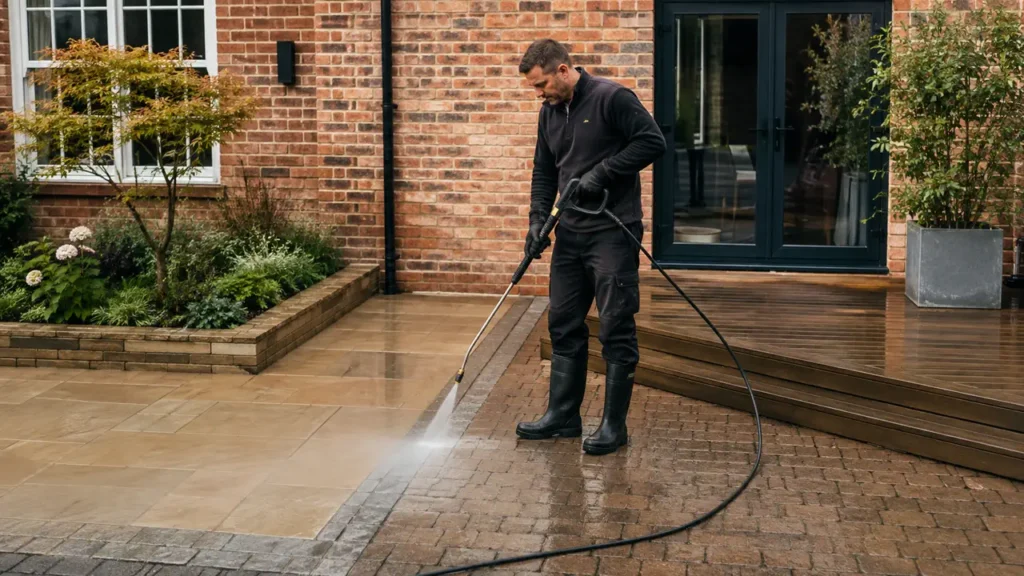
Pressure washing can remove years of dirt, algae, moss and general weathering from outdoor surfaces, but that does not mean every part of a property should be cleaned with the same machine setting or technique.
So, what can be pressure washed safely? Robust surfaces such as suitable concrete, block paving and some patio materials can often be pressure washed effectively. Brickwork, natural stone, timber, composite decking and older or damaged surfaces may require much more careful treatment.
The safest approach is to identify the material, inspect its condition and choose the cleaning method before applying high-pressure water.
What Surfaces Can Usually Be Pressure Washed?
Pressure washing is commonly used on hard exterior areas such as:
- Suitable concrete driveways
- Block paving
- Many patio paving surfaces
- Paths and entrances
- Some brick and masonry surfaces
- Some natural stone when an appropriate low-impact method is used
- Suitable timber or composite decking when manufacturer guidance permits it
However, the important word is suitable. Two surfaces made from the same general material can behave differently because of age, weathering, existing damage, previous treatment and construction.
Crown Clean London provides professional pressure washing in London and assesses the surface before deciding how it should be cleaned.
Can You Pressure Wash a Concrete Driveway?
Sound concrete is one of the exterior surfaces commonly suited to controlled pressure washing.
Over time, driveways can collect:
- General dirt and grime
- Algae and organic growth
- Vehicle-related marks
- Mud and soil
- Weather-related discolouration
Pressure washing can remove much of this surface contamination, but the concrete should still be inspected first.
Cracks, loose areas, deteriorating concrete or previous repairs may require a more cautious approach. Directing concentrated high pressure at a damaged section can potentially make an existing defect worse.
If your driveway requires cleaning, Crown Clean provides professional driveway cleaning in London for suitable surfaces.
Can Block Paving Be Pressure Washed?
Yes, block paving can often be pressure washed, but the joints require particular attention.
High-pressure water can remove dirt from the blocks while also disturbing some of the jointing sand between them.
For that reason, block paving should not simply be cleaned by directing a concentrated jet into every joint.
Before cleaning, consider:
- The condition of the blocks
- Whether any blocks are loose
- The condition of the jointing sand
- Existing weeds and organic growth
- Whether re-sanding may be required afterwards
Paving manufacturer Marshalls recommends matching the pressure to the surface and using controlled technique rather than unnecessarily aggressive cleaning.
You can read its guidance on pressure washing patios, driveways and decking.
Can You Pressure Wash Patio Slabs?
Many patio surfaces can be pressure washed, but the correct method depends heavily on what the slabs are made from.
A robust concrete paving slab may tolerate a different approach from sandstone, limestone, porcelain or another more sensitive surface.
Pressure washing may be useful for removing:
- Surface dirt
- Algae
- Moss
- Organic debris
- General weathering
However, joints, edges and previously damaged slabs should be treated carefully.
For patios affected by heavy weathering or organic growth, see Crown Clean London’s professional patio cleaning service.
Can Natural Stone Be Pressure Washed?
Natural stone should not automatically be treated like ordinary concrete.
Different stones vary in hardness, porosity, surface finish and condition. Sandstone, limestone and other natural paving materials can require lower pressure or a different cleaning method.
Marshalls specifically advises using lower pressure when cleaning natural stone paving, sandstone and porcelain outdoor tiles because unnecessarily high water pressure may affect the surface.
Before cleaning natural stone, consider:
- The exact stone type
- Whether the surface is weathered
- Existing flaking or deterioration
- The joint condition
- Previous sealers or treatments
- The type of contamination being removed
If you are unsure what type of stone you have, avoid experimenting with maximum pressure.
Crown Clean provides stone cleaning in London where a more material-specific cleaning approach may be appropriate.
Can You Pressure Wash Brickwork?
Brick can sometimes be cleaned using controlled water-based methods, but brickwork requires more caution than many people realise.
The condition and age of both the bricks and mortar are important. Strong water pressure on vulnerable masonry can damage the face of the brick or deteriorating mortar.
Historic England warns that overzealous cleaning with high-pressure jets can roughen masonry surfaces and cause significant damage.
You can read its guidance on cleaning and biological growth on masonry.
This is particularly relevant for older London properties, where brickwork may already have experienced decades of weathering.
Before cleaning brickwork, check for:
- Soft or crumbling mortar
- Spalled or damaged brick faces
- Previous repairs
- Paint or coatings
- Historic or delicate masonry
- Existing moisture-related problems
For suitable properties, Crown Clean offers professional brickwork cleaning in London.
Can You Pressure Wash Old Brick?
Old brickwork deserves an especially cautious approach.
Age alone does not tell you whether pressure washing is safe. What matters is the condition of the brick face, mortar, previous repairs and any historic significance.
If mortar is already soft or the brick surface is deteriorating, aggressive pressure cleaning can cause unnecessary damage.
For older masonry, the correct decision may be to reduce pressure significantly, use another cleaning method or avoid intervention altogether in particularly sensitive areas.
Can Decking Be Pressure Washed?
Some decking can be pressure washed, but timber should generally be approached with much less force than hard paving.
Excessive pressure can potentially:
- Raise or damage timber fibres
- Split or splinter vulnerable wood
- Create visible cleaning lines
- Damage weathered sections
- Affect coatings or finishes
When pressure washing suitable timber decking, Marshalls recommends beginning on a low setting and using a wider spray rather than placing a concentrated jet very close to the timber.
The cleaning direction and distance from the surface also matter.
Can Composite Decking Be Pressure Washed?
Composite decking should be treated according to the instructions for the particular product.
Composite boards are manufactured differently from traditional timber, and different brands can specify different cleaning methods and limits.
Do not assume that a pressure setting suitable for a concrete patio will also be suitable for composite boards.
Where the manufacturer’s instructions are unknown, a conservative cleaning approach is preferable until the material has been properly identified.
Crown Clean provides decking cleaning in London for suitable timber and composite surfaces.
Can Painted Surfaces Be Pressure Washed?
Painted exterior surfaces need careful assessment.
High-pressure water can lift weak, peeling or poorly adhered paint. Even sound coatings may not be designed for close-range high-pressure cleaning.
Before using a pressure washer on a painted surface, consider:
- The condition of the paint
- The material underneath it
- Whether the coating is already peeling
- The manufacturer’s care instructions
- Whether a lower-pressure wash would be sufficient
If the intention is to prepare a surface for repainting, the correct preparation method may also depend on the coating system being used afterwards.
Can Render Be Pressure Washed?
Render should not automatically be pressure washed.
Rendered walls vary considerably in composition, finish, age and condition. Aggressive pressure may damage weak or cracked render or force water into existing defects.
Because Crown Clean London does not currently have a dedicated render-cleaning service page, this guide should not be taken as an offer of specialist render cleaning.
If you are unsure about a rendered surface, identify the render system and follow the manufacturer’s maintenance guidance before deciding how it should be cleaned.
Should Roofs Be Pressure Washed?
A roof should never be treated as simply another patio or driveway.
Roof tiles vary in material, age and condition, and roof cleaning also introduces working-at-height risks that are not present when cleaning a driveway from ground level.
The correct roof-cleaning method should therefore be selected specifically for the roof rather than automatically using high-pressure water.
If your roof has moss or visible organic growth, Crown Clean provides roof cleaning in London using an approach based on the roof and its condition.
What Surfaces Should Make You Stop Before Pressure Washing?
Do not immediately begin pressure washing if you notice:
- Loose bricks or paving
- Cracked or crumbling mortar
- Flaking natural stone
- Unstable patio slabs
- Loose render
- Peeling paint
- Damaged timber
- Unknown composite materials
- Fragile historic masonry
- Electrical equipment or connections exposed to the cleaning area
Existing damage should be assessed before cleaning because removing surface dirt does not repair structural or material defects.
Why Starting With Lower Pressure Matters
A sensible principle is to use the least aggressive method that can clean the surface effectively.
Starting too aggressively gives you little room to correct a mistake after material has been damaged.
Where pressure washing is appropriate:
- Identify the surface first.
- Inspect for damage.
- Check manufacturer guidance where available.
- Test a small, inconspicuous area if appropriate.
- Begin conservatively.
- Increase cleaning intensity only when the surface can tolerate it.
Professional cleaning is about controlling the process rather than simply using the most powerful equipment available.
Pressure Washing Safety Around the Home
Pressure washing also creates safety considerations beyond the condition of the surface.
Water, electricity and high-pressure equipment require appropriate care. The Health and Safety Executive publishes specific guidance concerning electrical risks from steam and water pressure cleaners.
You can read the HSE guidance on electrical risks from pressure cleaners.
Other practical considerations include:
- Keeping people and pets away from the working area
- Using suitable footwear
- Controlling debris thrown from the surface
- Protecting nearby doors, windows and delicate objects
- Considering where dirty water will drain
- Using equipment according to its instructions
DIY or Professional Pressure Washing?
DIY pressure washing may be practical for a sound, familiar surface when you have suitable equipment and understand how to use it.
Professional pressure washing may be preferable when:
- You are unsure what material you have
- The property includes several different surfaces
- The surface is old or weathered
- There is significant algae, moss or ingrained dirt
- Brickwork or natural stone requires assessment
- The area is large
- You are concerned about damaging joints or finishes
The value of professional cleaning is not simply access to a powerful pressure washer. It is knowing when pressure is suitable, how much is appropriate and when a different approach should be used instead.
Professional Pressure Washing in London
Crown Clean London provides pressure washing and exterior cleaning across London and selected surrounding locations.
Before quoting, photographs can help us understand the surface, condition, contamination and access.
You can also view examples of completed work in our exterior cleaning gallery.
Need Help Cleaning an Exterior Surface?
If you are unsure whether your driveway, patio, paving, brickwork, stone or decking can be safely pressure washed, avoid experimenting with maximum pressure.
Send Crown Clean London clear photographs of the area together with your postcode. We can review the surface and advise on the most appropriate next step for services we provide.
Request an exterior cleaning quote from Crown Clean London.
Frequently Asked Questions
What surfaces can be pressure washed safely?
Suitable concrete, block paving and many patio surfaces can often be pressure washed. Brick, natural stone, decking and other sensitive materials may require lower pressure or another cleaning method depending on their condition.
Can pressure washing damage paving?
Yes. Excessive pressure can affect some paving surfaces and disturb jointing material. Identify the paving and use an appropriate cleaning technique rather than assuming maximum pressure is safe.
Can you pressure wash natural stone?
Some natural stone can be cleaned using controlled water pressure, but stone type and condition matter. Sandstone and other sensitive materials may require significantly lower pressure or another cleaning method.
Can you pressure wash brick walls?
Brickwork may sometimes be cleaned with controlled water-based methods, but vulnerable brick faces and mortar can be damaged by excessive pressure. Older or historic masonry requires particular care.
Can you pressure wash decking?
Some timber and composite decking can be pressure washed when the material manufacturer permits it. Timber normally requires a gentler approach than paving, while composite-board cleaning instructions can vary by manufacturer.
Is maximum pressure better for exterior cleaning?
No. More pressure does not automatically produce a better result. The aim is to use enough cleaning action to remove contamination without unnecessarily damaging the material.
Should I test a pressure washer before cleaning the whole surface?
Where appropriate, beginning with a small inconspicuous test area and a conservative setting can help establish how a surface responds before cleaning a larger area.
How can I find out if Crown Clean can clean my surface?
Send clear photographs of the surface together with your postcode through the Crown Clean London contact page. This helps identify the relevant service and whether the property is within the service area.