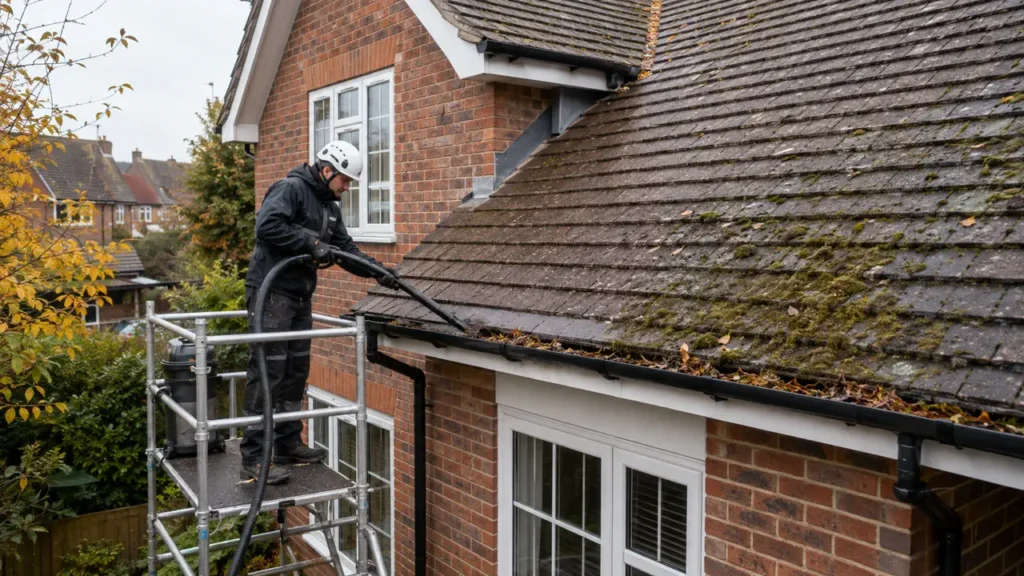
As summer moves into autumn, roofs and gutters have an increasingly important job to do. Falling leaves, roof moss, organic debris and wetter weather can expose problems that were easy to overlook during drier months.
Roof and gutter cleaning before autumn can help identify and remove accumulated debris before it contributes to overflowing gutters or repeated water flow where it should not be going.
That does not mean every roof and gutter system needs to be cleaned at exactly the same time every year. The condition of the roof, nearby trees, amount of moss and history of gutter blockages should determine what attention a property needs.
This guide explains what London homeowners should check before autumn and when professional roof or gutter cleaning may be worth considering.
Why Check Your Roof and Gutters Before Autumn?
Late summer and early autumn are useful times to inspect a property’s roofline because existing debris can combine with newly falling leaves as the season progresses.
Long-term Met Office climate averages for Heathrow show that rainfall and the number of days with measurable rain increase from September into October. That does not predict the weather for any individual year, but it illustrates why it makes sense to ensure rainwater systems are ready before the wetter part of autumn.
You can review the Met Office long-term climate averages for Heathrow.
A useful autumn property check should consider both the roof and the guttering because material from the roof can eventually end up inside the gutters.
How Are Roof and Gutter Problems Connected?
The roof and guttering perform different jobs, but they form part of the same rainwater pathway.
Rain falls onto the roof, moves towards the roof edge and enters the gutters before being directed towards downpipes and drainage.
Problems can develop when that path becomes obstructed.
For example:
- Loose roof moss can fall into gutters.
- Leaves can collect at roof edges and inside gutter channels.
- Organic debris can accumulate around downpipe openings.
- Blocked gutters can overflow during rainfall.
- Repeated overflow can wet walls and surrounding exterior surfaces.
This is why assessing roof and gutter cleaning together can sometimes be more useful than repeatedly clearing a gutter without considering where the debris is coming from.
1. Check for Moss on the Roof
Moss is common on roofs that remain shaded or damp for long periods. It may develop more heavily on some elevations than others depending on sunlight, nearby trees and local conditions.
The presence of moss does not automatically mean a roof needs aggressive cleaning. However, significant growth deserves attention because loose material can gradually move down the roof and into guttering.
From ground level, look for:
- Large areas of visible moss
- Loose clumps near the roof edge
- Moss collecting in valleys or lower sections
- Pieces of moss already visible inside the gutters
- Repeated gutter blockages where roof moss may be contributing
If the roof itself requires attention, Crown Clean London provides professional roof cleaning in London using an approach selected according to the roof and its condition.
2. Look for Leaves and Debris in the Gutters
Leaves are one of the most obvious autumn gutter problems, but they are not the only material that can accumulate.
Gutters may contain:
- Leaves
- Moss
- Small twigs
- Seeds
- Silt
- Organic debris
- Material disturbed from the roof
When this material accumulates, the available space for rainwater is reduced.
A gutter that appears manageable during light rain may overflow when rainfall becomes heavier.
Crown Clean provides gutter cleaning in London to remove accessible leaves, moss, silt and other debris restricting normal water flow.
3. Watch the Gutters When It Rains
One of the easiest ways to identify a potential gutter problem is to observe the property safely from ground level during rainfall.
Look for:
- Water spilling over the front edge
- Overflow concentrated around one section
- Water running down an exterior wall
- Unusual dripping around gutter joints
- Water collecting instead of moving towards the downpipe
- Very little apparent flow from an expected outlet
Overflow does not always mean the gutter simply needs cleaning. Damaged guttering, poor alignment, defective joints or drainage problems can also affect performance.
Professional cleaning removes debris, but it should not be confused with structural gutter repair.
4. Look for Signs of Roof Debris Reaching the Gutters
If gutters have recently been cleaned but quickly fill again with moss, the source may be higher up the property.
This is particularly worth investigating when:
- Large pieces of moss appear repeatedly in the gutters
- The roof has extensive visible organic growth
- Downpipe entrances repeatedly become obstructed
- The same gutter section blocks soon after cleaning
In these circumstances, repeatedly cleaning only the gutter may deal with the immediate symptom without addressing an ongoing source of debris.
That does not mean roof cleaning is automatically necessary. The roof should first be assessed to determine its material, condition and whether cleaning is appropriate.
5. Check for Vegetation Growing From the Gutter
If grass, weeds or small plants are visibly growing from a gutter, organic material has usually been accumulating for some time.
Seeds can settle into decomposing leaves, moss and silt, creating enough material for vegetation to establish itself.
Visible plant growth is therefore a strong sign that the gutter deserves attention rather than waiting until water begins overflowing heavily.
6. Check the Downpipe Areas
A gutter channel can look relatively clear while water is still being restricted near the entrance to a downpipe.
Leaves and moss can gather around these points because water naturally carries loose material towards the outlet.
Signs of a possible restriction include:
- Water backing up near the downpipe
- Overflow concentrated close to the outlet
- Visible debris covering the opening
- Water remaining in the gutter after rainfall
If the problem continues after accessible gutter debris has been removed, further investigation may be necessary.
7. Look for Water Marks Around the Roofline
Repeated water staining beneath guttering can indicate that rainwater is escaping somewhere it should not.
Possible causes include:
- Blocked gutters
- Leaking gutter joints
- Damaged gutter sections
- Incorrect gutter alignment
- Downpipe restrictions
If debris is clearly causing overflow, cleaning may resolve the immediate obstruction. If staining continues afterwards, the gutter system may need repair rather than further cleaning.
Should Roof and Gutter Cleaning Always Be Done Together?
No. Roof and gutter cleaning should be based on the actual condition of each part of the property.
Gutter cleaning alone may be appropriate when:
- The roof has little or no moss
- Most debris comes from nearby trees
- The gutters have simply accumulated leaves
- The roof surface itself is in good condition
It may make sense to assess both roof and gutters when:
- The roof has substantial moss growth
- Moss repeatedly fills recently cleared gutters
- The property has not been maintained for a long time
- There is significant organic growth across the roofline
- You are unsure where repeated gutter debris is coming from
Crown Clean provides both services separately, which means the appropriate work can be based on the property’s condition rather than automatically adding unnecessary cleaning.
Is Autumn the Best Time for Roof Cleaning?
There is no universal best month for every roof.
The appropriate timing depends on:
- Roof condition
- Weather
- Access
- Type of roof covering
- Amount of moss or contamination
- The cleaning method being considered
Autumn can be a useful time to identify problems because leaves and wetter weather make gutter performance more noticeable, but roof work should only be carried out when conditions and access allow it to be done safely.
Is Roof Cleaning a DIY Job?
Roof cleaning introduces an important issue that patio and driveway cleaning usually do not: working at height.
The Health and Safety Executive states that roof work is hazardous because of the risk of falls and specifically includes cleaning work within its roof-work guidance.
You can read the HSE guidance on health and safety in roof work.
HSE also states that work at height should be properly planned, supervised and carried out by people with the necessary competence and suitable equipment.
For homeowners, the practical message is straightforward: do not climb onto a roof simply because moss or debris looks easy to reach.
Can Roof and Gutter Checks Be Done From Ground Level?
Many initial warning signs can be noticed without climbing onto the property.
From a safe position at ground level, you may be able to see:
- Large areas of roof moss
- Vegetation growing from gutters
- Visible leaf accumulation
- Overflow during rainfall
- Staining beneath gutters
- Loose or sagging gutter sections
Photographs taken safely from ground level can also be useful when requesting professional advice.
HSE’s work-at-height guidance recommends considering whether the task can be carried out without working at height in the first place. You can read its step-by-step guidance for managing work at height.
Why Roof Cleaning Method Matters
A roof should not automatically be treated in the same way as a driveway or patio.
Different roof coverings vary in age, construction and condition. Existing defects or fragile areas can also affect what type of cleaning is appropriate.
Before roof cleaning is considered, factors should include:
- Roof material
- Age and general condition
- Amount and type of organic growth
- Existing damage
- Safe access
- Nearby gutters and drainage
- The most appropriate cleaning method
The strongest possible cleaning method is not automatically the best option.
Why Gutter Cleaning Method Matters Too
Gutters may look simple, but accessing them safely can be more difficult than removing the debris itself.
A professional assessment should consider:
- Building height
- Safe access
- Gutter material
- Amount of debris
- Nearby conservatories or extensions
- Downpipe locations
- Any visibly damaged sections
The objective is to clear the obstruction without creating unnecessary risk or damaging the guttering.
Autumn Roof and Gutter Checklist for London Homes
- Inspect the roof from ground level. Look for obvious moss, loose debris or visibly damaged areas.
- Look inside visible gutter sections. Check for leaves, moss, vegetation and accumulated debris.
- Watch the gutters during rainfall. Overflow can reveal restrictions that are less obvious in dry weather.
- Check the exterior walls. Look for repeated staining or wet areas beneath gutter sections.
- Consider nearby trees. Mature trees can significantly increase the amount of seasonal debris reaching the roof.
- Check whether roof moss is entering the gutters. Repeated moss accumulation may indicate that both areas deserve assessment.
- Look around downpipe entrances. These areas can become collection points for leaves and moss.
- Do not climb onto the roof unnecessarily. Roof work involves significant work-at-height risks.
- Arrange professional assessment where access or cleaning is unsafe.
Should You Wait Until Gutters Overflow?
No. Visible overflow is useful evidence of a problem, but there is no advantage in deliberately waiting for a blockage to become severe.
If gutters already contain obvious leaves, moss or vegetation, dealing with the debris before sustained autumn rainfall is more sensible than waiting for water to repeatedly spill over the gutter edge.
Preventive inspection is particularly worthwhile on properties that have experienced gutter blockages in previous years.
Roof and Gutter Cleaning Across London
Crown Clean London provides exterior cleaning across London and selected surrounding locations.
Coverage includes areas such as Wembley, Watford, Borehamwood, Chelsea, Potters Bar and Gerrards Cross.
You can view all areas covered by Crown Clean London or send your postcode when requesting a quotation.
Need Roof or Gutter Cleaning Before Autumn?
If your roof has significant moss, your gutters are filling with debris or water is overflowing during rainfall, Crown Clean London can assess which cleaning service is appropriate for the property.
You do not automatically need both services. Send clear photographs of the roofline and gutters together with your postcode, and the condition of each area can be considered separately.
You can also view previous exterior cleaning work in the Crown Clean London cleaning results gallery.
Request a roof or gutter cleaning quote from Crown Clean London.
Frequently Asked Questions
Should roof and gutter cleaning be done together?
Not always. Gutter cleaning alone may be enough when debris mainly comes from nearby trees. Assessing both can be useful where substantial roof moss repeatedly falls into recently cleared gutters.
When should gutters be cleaned before autumn?
There is no fixed date for every property. Late summer or early autumn is a useful time to inspect gutters before significant leaf fall and wetter autumn conditions. Properties surrounded by trees may benefit from another check after leaves have fallen.
Can roof moss block gutters?
Yes. Pieces of moss can loosen from a roof and accumulate alongside leaves and silt inside gutters or near downpipe entrances, potentially restricting rainwater flow.
How do I know if my gutters are blocked?
Common signs include overflowing water during rainfall, visible leaves or vegetation, debris around downpipe openings and repeated water staining beneath the guttering.
Can I clean roof moss myself?
Roof cleaning can involve hazardous work at height. HSE advises that roof work should be properly planned and carried out using suitable precautions and competent people. Avoid climbing onto a roof if the task cannot be carried out safely.
Does every mossy roof need cleaning?
No. The amount of moss, roof material, condition and effect on the property should be considered. Cleaning should not be carried out simply because a small amount of natural weathering is visible.
Can blocked gutters cause damp?
Overflowing gutters can repeatedly wet external walls, but damp can have several possible causes. Clearing an obvious gutter blockage is sensible, but persistent moisture problems should be properly investigated rather than automatically attributed to the gutter.
Does Crown Clean provide roof and gutter cleaning near me?
Crown Clean provides roof and gutter cleaning services across London and selected surrounding areas. Send your postcode through the contact page to confirm coverage.