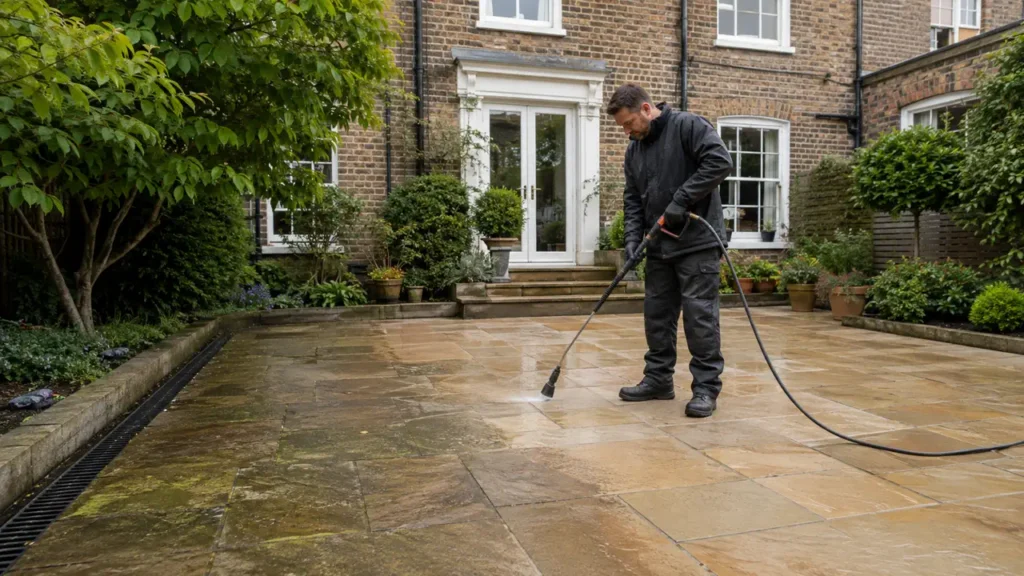
Natural stone can make a patio, path, entrance or other outdoor area look distinctive, but it should not automatically be cleaned in the same way as concrete or standard block paving.
Safe natural stone cleaning starts by identifying the stone, assessing its condition and using the least aggressive method capable of removing the contamination. Excessive pressure, unsuitable chemicals or repeated aggressive cleaning can permanently alter some stone surfaces.
This guide explains how outdoor natural stone can be maintained, when pressure washing may be appropriate, which common mistakes to avoid and when professional stone cleaning is worth considering.
Why Does Natural Stone Need Special Cleaning?
Natural stone is not one uniform material. Sandstone, limestone, granite and other stone types differ in hardness, porosity, texture, mineral composition and resistance to cleaning methods.
The age and condition of the surface matter too. Two sandstone patios can respond differently if one is relatively new and sound while the other is heavily weathered, flaking or affected by deteriorating joints.
Before cleaning natural stone, consider:
- The type of stone
- Its age and condition
- Whether the surface is smooth, textured or weathered
- The condition of joints
- Previous sealers or treatments
- The type of dirt or staining
- Existing cracks, flaking or deterioration
- Nearby plants and other materials
Stone Federation Great Britain stresses that stone cleaning requires appropriate knowledge because the wrong process can cause damage that may not be easy to reverse.
You can read its guidance on cleaning natural stone.
Crown Clean London provides professional stone cleaning in London for suitable exterior stone surfaces.
What Is the Safest Way to Start Cleaning Natural Stone?
Start gently rather than immediately reaching for maximum pressure or a strong chemical cleaner.
For routine exterior maintenance, a sensible starting process can include:
- Remove furniture and loose objects where practical.
- Sweep away leaves, soil and loose debris.
- Identify the stone if possible.
- Inspect for cracks, flaking or loose joints.
- Check any available manufacturer or supplier care guidance.
- Use a mild cleaning method appropriate for the particular stone.
- Test an inconspicuous area before treating the entire surface.
- Rinse thoroughly where the cleaning method requires it.
The important principle is to increase cleaning intensity only when necessary rather than beginning with the harshest available method.
Can You Clean Natural Stone With Soap and Water?
For some outdoor stone and light everyday dirt, warm water with an appropriate mild, acid-free cleaning product can be a useful starting point.
For example, Marshalls recommends warm soapy water and an acid-free soap-based product as a straightforward method for maintaining its Indian sandstone paving.
You can read the Marshalls Indian sandstone cleaning guide.
A typical gentle cleaning process may involve:
- Sweeping loose material away
- Applying the appropriate diluted cleaning solution
- Agitating the surface with a suitable brush
- Rinsing thoroughly with clean water
- Allowing the stone to dry before assessing the final result
However, guidance for one sandstone product should not automatically be applied to every type of natural stone.
Can Natural Stone Be Pressure Washed?
Some natural stone can be pressure washed, but the pressure and technique need to suit the material and its condition.
Pressure washing may be useful for suitable outdoor stone affected by general dirt or organic contamination, but unnecessarily high pressure can erode vulnerable surfaces or create an uneven appearance.
Marshalls recommends keeping pressure low on natural stone paving, sandstone and similar sensitive exterior surfaces.
Its broader pressure washing guidance advises starting conservatively and using pressure suited to the paving material.
If controlled pressure cleaning is appropriate for your property, Crown Clean also provides professional pressure washing in London.
Can Too Much Pressure Damage Natural Stone?
Yes. Excessive pressure can damage certain natural stone surfaces, particularly where the material is softer, weathered or already deteriorating.
Potential problems include:
- Loss of surface material
- Roughening of the stone
- Accelerated erosion of weak areas
- Damage around joints
- Uneven cleaning marks
- Making existing cracks or flaking more noticeable
Historic England advises against unnecessary high-pressure cleaning of vulnerable historic stone because repeated or aggressive cleaning can damage the original masonry.
You can read Historic England’s guidance discussing appropriate stone cleaning methods.
Can Sandstone Be Pressure Washed?
Sandstone can sometimes be cleaned with controlled pressure, but it should generally be treated more cautiously than robust concrete.
Before pressure washing sandstone, check for:
- Loose or flaking surface material
- Weathered edges
- Damaged joints
- Previous surface coatings
- Cracks
- Areas that already appear softer than surrounding stone
Where pressure washing is appropriate, starting at lower pressure and testing a discreet section is safer than immediately applying a concentrated high-pressure jet.
How Should Indian Sandstone Be Cleaned?
Indian sandstone is widely used for garden patios and paths because of its natural variation in colour and texture.
For routine maintenance, Marshalls recommends regular brushing and describes warm soapy water with an acid-free product as a simple cleaning method for its Indian sandstone.
Where a pressure washer is used, its guidance recommends:
- Using a low-pressure setting
- Testing the water pressure first
- Avoiding unnecessarily aggressive cleaning
- Taking care around joints
Because sandstone products vary, any supplier or manufacturer instructions for the actual paving should take priority over generic advice.
Can Limestone Be Pressure Washed?
Limestone also needs a material-specific approach.
Its finish, condition and mineral composition can affect how it responds to pressure and cleaning chemicals.
If the exact stone is uncertain, avoid assuming that a method suitable for concrete or another type of paving is automatically safe for limestone.
Professional assessment can be particularly useful where:
- The stone has become heavily discoloured
- The surface appears worn or delicate
- There is extensive biological growth
- Previous treatments are unknown
- The patio contains several types of stone
What About Granite and Harder Natural Stone?
Some granite surfaces are considerably harder than sandstone or limestone, but hardness alone does not mean unlimited pressure is appropriate.
The condition of the joints, surface finish, installation and any previous treatment still need to be considered.
A polished or specially finished stone surface can also require different care from rough outdoor granite paving.
The stone type should therefore be only one part of the assessment.
Can You Use Acid to Clean Natural Stone?
Do not use acidic cleaning products on natural stone unless you know that the particular product is suitable for that specific stone.
Acids can react with certain minerals and can permanently affect some stone surfaces.
Marshalls specifically advises avoiding acid-containing cleaning solutions on its Indian sandstone because they can cause discolouration or rust-like staining.
If you are dealing with a difficult stain:
- Identify the stone.
- Identify the stain if possible.
- Check the stone supplier’s care instructions.
- Choose a compatible cleaning product.
- Test a small discreet area first.
- Avoid increasing chemical strength simply because the first attempt was unsuccessful.
Is Bleach Safe for Natural Stone?
The answer depends on the stone, the product being used and the manufacturer’s guidance.
Some paving manufacturers publish diluted bleach cleaning methods for certain stone products, while other natural stone surfaces or finishes may have different restrictions.
For this reason, it would be misleading to say that household bleach is universally safe or universally unsafe for every natural stone surface.
When the stone type or previous treatment is uncertain, a stone-compatible product and conservative method are safer than experimenting across the entire patio.
Can You Use Vinegar on Natural Stone?
Vinegar is acidic, so it should not be treated as a universal natural-stone cleaner.
Acid-sensitive stone can react with acidic products, potentially changing its surface or appearance.
DIY cleaning advice found online may describe vinegar as a general household cleaner, but that does not make it suitable for every stone material.
Always base the cleaning product on the stone rather than on how commonly the product is used elsewhere around the home.
How Do You Remove Green Algae From Natural Stone?
Green biological growth is common on patios and paths that remain shaded or damp.
Cleaning can remove existing surface contamination, but it is also worth considering why the area stays wet.
Conditions that encourage recurring algae can include:
- Heavy shade
- Nearby trees
- Leaves remaining on the paving
- Slow drainage
- Limited airflow
- Persistent dampness
A suitable cleaning method can improve the appearance of the stone, while regular sweeping and keeping drainage areas clear can help reduce the amount of organic material left on the surface.
Can Moss Damage Natural Stone?
Moss itself often develops where conditions remain damp and shaded, but removing it aggressively can cause more harm than the growth if the underlying stone is delicate.
Before cleaning moss-covered stone:
- Remove loose organic debris
- Assess whether the stone is sound
- Inspect joints
- Choose a method suitable for the material
- Avoid attacking one small area with concentrated pressure
If organic growth covers a large patio, Crown Clean’s professional patio cleaning service may also be relevant depending on the paving material.
How Do You Remove Black Spots From Natural Stone?
Dark spots and persistent biological staining can be more difficult to remove than ordinary surface dirt.
The temptation is often to increase pressure dramatically or apply increasingly strong chemicals. That should not be the first response.
Before treating stubborn black staining:
- Identify the stone.
- Check whether the surface is already weathered.
- Establish whether the staining is biological or another type of mark.
- Select a stone-compatible treatment.
- Test the treatment in an inconspicuous area.
- Allow the recommended contact time rather than compensating with excessive pressure.
Some contamination cannot be removed completely without causing unacceptable change to the underlying material. In those cases, protecting the stone is more important than chasing an unrealistic uniform finish.
What Causes Rust-Like Marks on Natural Stone?
Orange or brown marks can have several possible causes, including metal objects, mineral content in the stone or reactions involving unsuitable chemicals.
Because the cause matters, applying a random stain remover can make the problem worse.
If unusual discolouration appears after cleaning, stop applying additional products until the stone and likely cause have been identified.
Should Natural Stone Be Sealed After Cleaning?
Not every outdoor natural stone surface automatically requires sealing.
Whether sealing is appropriate depends on:
- The stone type
- Its porosity
- Surface finish
- Location
- The desired appearance
- Existing treatments
- The particular sealer being considered
Applying an unsuitable sealer to damp or contaminated stone can create additional appearance problems.
If sealing is planned, follow the stone and sealer manufacturer’s instructions and make sure the surface has been prepared and dried as required.
Can Old Natural Stone Be Cleaned?
Yes, but older stone usually deserves greater caution.
Historic or heavily weathered natural stone can contain:
- Open joints
- Cracks
- Flaking surfaces
- Previous repairs
- Areas of material loss
- Old coatings or treatments
Stone Federation Great Britain notes that deterioration can sometimes be hidden beneath dirt and heavy soiling. Removing that dirt may reveal defects that were already present.
This is one reason why an initial inspection matters before an apparently dirty surface is subjected to intensive cleaning.
Should Historic Stone Look Brand New After Cleaning?
No. The objective of appropriate stone cleaning should not always be to make old stone look newly installed.
Natural colour variation, weathering and age can form part of the character of older stone.
Historic England warns that repeated cleaning can itself cause material loss. Removing original surface material simply to achieve a perfectly uniform colour is therefore not a sensible objective.
A successful clean should balance appearance with preservation of the stone.
Why Is a Test Patch Important?
A test area is one of the most useful precautions when cleaning an unfamiliar natural stone surface.
It can help show:
- Whether the contamination responds to the proposed method
- Whether the stone changes colour
- Whether the surface becomes rougher
- Whether jointing is affected
- Whether the cleaning product leaves residue
- Whether a gentler method would achieve an acceptable result
The test should be performed somewhere relatively discreet where possible.
Common Natural Stone Cleaning Mistakes
Using Maximum Pressure Immediately
A pressure washer’s maximum setting is not a target. Natural stone should be cleaned at an intensity appropriate for the material.
Assuming Every Stone Is the Same
Sandstone, limestone, granite and other stones can behave differently. Even two products marketed under the same general stone name may have different finishes or characteristics.
Using Acidic Household Cleaners
Products such as vinegar and strong acid cleaners may react with certain stones. Check compatibility first.
Ignoring Damaged Joints
A stone patio may have sound slabs but deteriorating joints. Aggressive pressure can remove already weak jointing material.
Trying to Remove Every Natural Colour Variation
Variation in tone may be part of the stone itself rather than dirt. Excessive cleaning can damage the surface without producing the uniform appearance being pursued.
Applying a Sealer Before the Stone Is Ready
Stone should be properly cleaned, prepared and dried according to the sealer instructions before treatment is considered.
DIY or Professional Natural Stone Cleaning?
Routine sweeping and gentle maintenance can be straightforward when you know exactly what stone you have and have the supplier’s care instructions.
Professional stone cleaning becomes more useful when:
- The stone type is uncertain
- The surface is heavily weathered
- There is extensive algae, moss or stubborn staining
- The joints are damaged
- Previous chemicals or sealers are unknown
- You are considering pressure washing
- The area is large
- The stone is old or valuable
- You are concerned about causing irreversible damage
The advantage of professional cleaning should not simply be access to powerful equipment. The important part is selecting a method appropriate for the particular stone.
Natural Stone Cleaning Checklist
- Identify the stone wherever possible.
- Inspect its condition before cleaning.
- Check joints for deterioration.
- Remove loose dirt and organic debris first.
- Check manufacturer or supplier cleaning guidance.
- Begin with the least aggressive suitable method.
- Avoid unverified acidic or harsh chemical cleaners.
- Test a discreet area.
- Use controlled pressure only where appropriate.
- Rinse cleaning products thoroughly where required.
- Allow the stone to dry before judging the final appearance.
Professional Natural Stone Cleaning in London
Crown Clean London provides professional exterior stone cleaning throughout London and selected surrounding locations.
Because different stone surfaces require different approaches, clear photographs are particularly useful when requesting a quotation.
Photographs should ideally show:
- The full area
- Close-ups of the stone
- Any heavy staining or organic growth
- Damaged or loose joints
- Any unusual marks you want assessed
You can also view examples of previous exterior cleaning work in the Crown Clean London before-and-after cleaning gallery.
Need Natural Stone Cleaning in London?
If your sandstone, limestone or other exterior stone has become weathered, stained or affected by organic growth, avoid assuming that maximum pressure or the strongest available chemical will provide the best result.
Crown Clean London can assess suitable exterior stone surfaces and recommend an appropriate cleaning approach.
Send clear photographs of the surface together with your postcode and, if known, the type or manufacturer of the stone.
Request a natural stone cleaning quote from Crown Clean London.
Frequently Asked Questions
What is the best way to clean natural stone outside?
The best method depends on the stone and its condition. Start by removing loose debris and use the least aggressive cleaning method suitable for the material. Manufacturer or supplier instructions should take priority where available.
Can you pressure wash natural stone?
Some natural stone can be pressure washed carefully, but high pressure can damage softer or weathered stone. Use lower pressure where appropriate, assess the surface first and test a discreet area.
Can sandstone be pressure washed?
Sandstone can sometimes be pressure washed at controlled lower pressure when it is in suitable condition. Avoid aggressive concentrated pressure and inspect the stone and joints before cleaning.
Can you use vinegar on natural stone?
Vinegar is acidic and should not be treated as a universal natural-stone cleaner. Acid-sensitive stone can react with it and suffer permanent surface changes.
Can you use bleach on natural stone?
Some stone-product manufacturers permit carefully diluted bleach for certain paving, while other stones or treatments may not be compatible. Follow guidance for the exact stone rather than assuming bleach is safe for everything.
How do you remove algae from natural stone?
Remove loose organic debris first and then use a stone-compatible cleaning method. Keeping the surface clear of leaves and addressing persistent shade or drainage issues can also help reduce conditions that encourage algae to return.
Should natural stone be sealed after cleaning?
Not necessarily. The decision depends on the stone, its porosity, location, existing treatment and the sealer being considered. Follow the stone and sealer manufacturer’s instructions before applying a treatment.
Can cleaning damage natural stone?
Yes. Excessive pressure, unsuitable chemicals, abrasive methods and repeated aggressive cleaning can damage natural stone. Correct identification and a conservative cleaning approach reduce this risk.
Does Crown Clean provide stone cleaning near me?
Crown Clean London provides professional stone cleaning across London and selected surrounding areas. Send your postcode and photographs through the contact page to confirm coverage.