Composite decking is designed to require less maintenance than traditional timber, but low maintenance does not mean no maintenance. Leaves, dirt, pollen, food spills and organic growth can still build up across the surface over time.
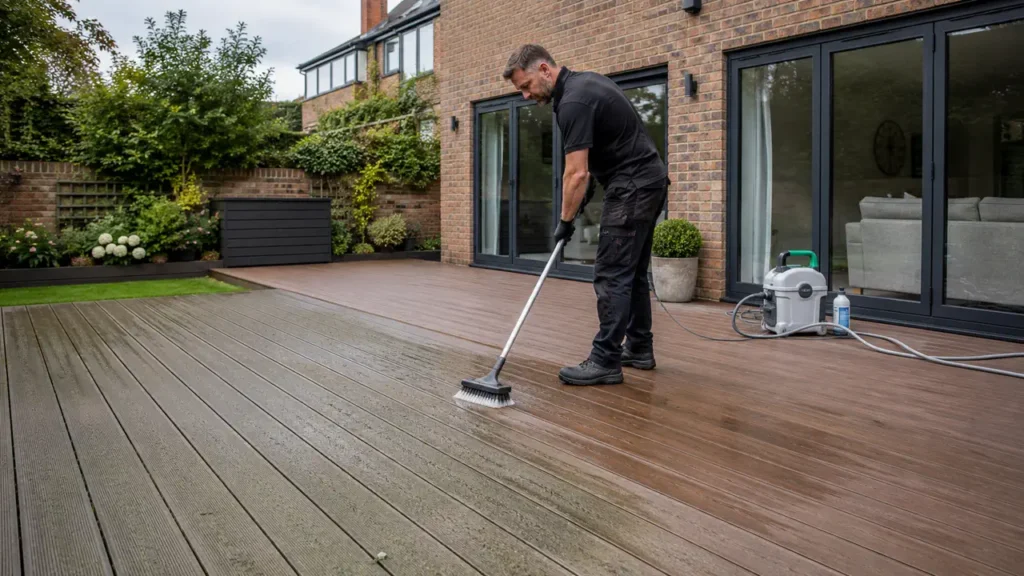
The safest way to clean composite decking is usually to start with the gentlest method recommended by the board manufacturer. For many products, that means removing loose debris before washing with warm soapy water and a soft-bristle brush.
Pressure washing may be suitable for some composite decking products, but not all manufacturers allow the same pressure, distance or technique. Identifying the decking product before using powerful equipment is therefore extremely important.
What Is the Best Way to Clean Composite Decking?
For general dirt and routine maintenance, a simple cleaning process is usually the best place to start.
- Remove furniture, plant pots and loose objects where practical.
- Sweep away leaves, dust and loose debris.
- Clear debris from the gaps between boards.
- Prepare warm water with a mild soap suitable for the decking.
- Use a soft-bristle brush to loosen dirt.
- Work along the direction of the boards where appropriate.
- Rinse the surface thoroughly with clean water.
- Allow the decking to dry naturally.
Trex recommends warm soapy water and a soft-bristle brush for routine dirt and debris on its current composite decking ranges.
You can read the manufacturer’s Trex composite decking care and cleaning guidance.
EnviroBuild similarly recommends sweeping first, followed by warm soapy water and a soft-bristle brush for its composite decking.
Does Composite Decking Need Cleaning?
Yes. Composite decking may require significantly less ongoing treatment than traditional timber, but outdoor exposure still allows contamination to build up.
Common causes include:
- Leaves
- Pollen
- Dust
- Soil and mud
- Food and drink spills
- Grease from outdoor cooking
- Bird activity
- Algae or mould growing on accumulated organic material
Regular sweeping is particularly useful because leaves and organic debris can retain moisture and provide material on which biological growth develops.
If your decking has become heavily weathered or difficult to clean, Crown Clean London provides professional decking cleaning in London for suitable timber and composite surfaces.
Can You Pressure Wash Composite Decking?
Sometimes, but you should never assume that every composite decking board can be pressure washed in the same way.
Composite decking is produced by different manufacturers using different board structures, protective caps and materials. Cleaning instructions can therefore vary significantly.
For example, Trex permits controlled pressure washing on certain current high-performance product ranges when its specified equipment settings, fan tip and minimum distance are followed.
However, Trex advises against pressure washing some of its older-generation composite decking because doing so can damage the surface and affect warranty coverage.
EnviroBuild currently recommends that pressure washing its composite decking, where used, should be carried out at low pressure and with the washer kept away from the board surface.
You can compare this with the EnviroBuild composite decking care guide.
The practical lesson is simple: check the instructions for your exact decking product before using a pressure washer.
Why Is There No Universal Pressure Washer Setting?
One manufacturer’s safe maximum does not automatically apply to another manufacturer’s decking.
Composite boards may differ in:
- Surface coating
- Protective cap construction
- Wood and plastic composition
- Surface texture
- Age
- Generation of the product
- Warranty requirements
This is why using a generic internet recommendation such as “always use this PSI” can be misleading.
A safer process is:
- Identify the manufacturer if possible.
- Identify the specific board range.
- Read the manufacturer’s current cleaning instructions.
- Inspect the board for damage.
- Start with the least aggressive approved method.
- Only use pressure washing if the manufacturer permits it.
Can High Pressure Damage Composite Decking?
Yes. Excessive pressure, a concentrated jet or holding a pressure washer too close to the boards can damage some composite surfaces.
Possible problems include:
- Changes to surface texture
- Visible cleaning lines
- Damage to the protective outer layer
- Permanent marking
- Uneven appearance
- Warranty problems where cleaning instructions have not been followed
Pressure washing should therefore be treated as one possible cleaning method rather than the automatic first step.
If professional pressure cleaning is being considered for your property, Crown Clean also provides controlled pressure washing in London for suitable exterior surfaces.
How Do You Remove Algae From Composite Decking?
Green surface growth is often associated with damp, shade and organic debris remaining on the decking.
Before reaching for aggressive chemicals or high pressure:
- Sweep away leaves and loose material.
- Clear the gaps between boards.
- Wash the affected area according to the manufacturer’s instructions.
- Use a soft-bristle brush where permitted.
- Rinse the area thoroughly.
- Keep the decking clear of debris afterwards.
It is also worth considering why the area remains damp.
Common contributing factors include:
- Heavy shade
- Nearby trees
- Leaves remaining on the decking
- Debris blocking gaps between boards
- Limited airflow
- Poor drainage around the decking area
Cleaning removes existing contamination, but keeping debris off the boards can help reduce the conditions that allow it to return quickly.
Should You Use Bleach on Composite Decking?
Do not assume that household bleach or another strong chemical is safe for every composite product.
Some decking manufacturers specifically warn against harsh chemicals, solvents or cleaners that may affect colour or surface condition.
EnviroBuild, for example, advises against bleach and strong solvents for its composite decking.
If a stain does not respond to mild cleaning, check the board manufacturer’s stain-removal instructions before applying a stronger product.
When the exact decking product is unknown, testing aggressive chemicals without guidance can create a much bigger cosmetic problem than the original stain.
How Do You Remove Food and Grease From Composite Decking?
Outdoor dining and barbecues can leave food, oil and grease marks on decking.
The most important step is usually to deal with spills promptly rather than allowing them to remain on the surface.
For many composite products, the first approach will be:
- Remove solid food residue.
- Use warm soapy water.
- Agitate gently with a soft brush.
- Rinse thoroughly.
However, specific stain products should only be used if they are compatible with the decking manufacturer’s guidance.
Trex, for example, provides separate care instructions for food, oil and grease contamination on its products.
Can You Use Washing-Up Liquid on Composite Decking?
Some major composite-decking manufacturers recommend mild soap or washing-up liquid mixed with warm water for routine cleaning.
However, because formulations and products vary, always confirm the guidance for your particular decking before cleaning a large area.
When using soapy water:
- Use a mild product.
- Avoid unnecessarily strong concentrations.
- Use a soft-bristle brush.
- Rinse the boards thoroughly afterwards.
Leaving dirty or soapy water to dry on the surface may leave residue or visible marks.
Should You Scrub Composite Decking?
Gentle brushing is commonly recommended, but the type of brush matters.
A soft-bristle brush can help loosen dirt from textured surfaces without using aggressive abrasion.
Avoid using:
- Metal wire brushes
- Highly abrasive pads
- Aggressive scraping tools
- Sandpaper unless specifically approved by the manufacturer
Some composite surfaces have protective caps or embossed textures that can be permanently altered by abrasive cleaning.
Should Composite Decking Be Sanded?
Composite decking should not automatically be sanded like timber.
Trex specifically advises against sanding its decking because doing so changes the appearance and protective qualities of the surface.
Other manufacturers may have their own requirements.
If composite boards are scratched, stained or damaged, check the manufacturer’s repair guidance rather than treating them like conventional wooden decking.
How Do You Clean Between Composite Decking Boards?
The gaps between boards are an important part of decking maintenance because they allow water and debris to move away from the surface.
Leaves, dirt and other material can collect in these spaces.
Regularly removing loose debris helps:
- Maintain drainage
- Reduce standing water
- Improve airflow
- Prevent wet organic debris accumulating between boards
Use methods that will not damage the board edges or fixings.
If the gaps repeatedly become blocked, surrounding trees, garden debris or the general decking design may need to be considered.
How Often Should Composite Decking Be Cleaned?
There is no single schedule for every deck.
A useful approach is to sweep frequently and carry out a more thorough clean whenever dirt and organic material begin accumulating.
Cleaning frequency may need to increase when:
- The deck is beneath trees
- Leaves accumulate heavily
- The garden receives limited sunlight
- The surface remains damp for long periods
- The decking is used frequently for outdoor dining
- Pets regularly use the area
Manufacturer recommendations should take priority where a specific maintenance schedule is provided.
Should You Clean Composite Decking in Autumn?
Autumn is a particularly useful time to keep composite decking clear because falling leaves and organic debris can accumulate quickly.
Wet leaves can also make outdoor surfaces less pleasant to walk on and can hold moisture against the decking.
An autumn maintenance routine can include:
- Regularly sweeping leaves.
- Keeping board gaps clear.
- Removing food or plant stains.
- Checking whether water drains away normally.
- Cleaning heavier dirt before winter where appropriate.
Spring can also be a useful time for a more thorough clean before the garden is used more frequently.
Common Composite Decking Cleaning Mistakes
Using Maximum Pressure
A pressure washer capable of producing very high pressure does not mean the deck should be cleaned at that setting.
The manufacturer’s approved limit and technique should determine how the equipment is used.
Holding the Pressure Washer Too Close
Even when pressure washing is permitted, distance from the surface matters. A concentrated jet held too close can create more aggressive cleaning action than intended.
Assuming All Composite Boards Are the Same
This is one of the biggest mistakes.
Different manufacturers can give significantly different cleaning instructions, and even different generations from the same manufacturer may have different requirements.
Using Harsh Chemicals Without Checking
A product designed for concrete paving or another outdoor surface may not be suitable for composite decking.
Always verify chemical compatibility before treating the whole deck.
Using Abrasive Brushes
Metal brushes and highly abrasive cleaning pads can scratch or alter the surface.
Ignoring the Gaps Between Boards
Cleaning only the visible upper surface while leaving leaves and debris trapped between boards can reduce drainage and allow organic material to remain wet.
DIY or Professional Composite Decking Cleaning?
Routine sweeping and gentle soap-and-water cleaning can be straightforward for many homeowners when the manufacturer’s instructions are known.
Professional decking cleaning can become more useful when:
- The decking is heavily affected by algae or grime
- The manufacturer or board type is uncertain
- The area is large
- Previous cleaning has left uneven marks
- You are unsure whether pressure washing is suitable
- The deck contains stubborn staining
- You want to avoid experimenting with aggressive equipment
A professional cleaner should still consider the manufacturer requirements rather than treating composite decking like concrete paving.
Composite Decking Cleaning Checklist
- Identify the decking brand and product if possible.
- Read the manufacturer’s current cleaning guidance.
- Sweep away loose dirt and leaves.
- Clear debris from the gaps between boards.
- Start with mild soap, warm water and a soft brush where approved.
- Test cleaning products in a discreet area where appropriate.
- Only pressure wash if the manufacturer permits it.
- Follow the specified pressure, nozzle and distance requirements.
- Rinse away dirty water and cleaning residue thoroughly.
- Keep the decking clear of leaves and organic debris afterwards.
Professional Decking Cleaning in London
Crown Clean London provides decking cleaning services in London for suitable exterior decking surfaces.
Because composite products can have different cleaning requirements, clear photographs and any available information about the manufacturer are useful when requesting an assessment.
Crown Clean serves London and selected surrounding locations including Wembley, Watford, Borehamwood, Chelsea, Potters Bar and Gerrards Cross.
You can also view examples of our exterior cleaning work in the Crown Clean London gallery.
Need Help Cleaning Composite Decking?
If your composite decking has become covered with dirt, algae or general weathering and you are unsure which cleaning method is suitable, avoid using maximum pressure or strong chemicals before identifying the product.
Send Crown Clean London clear photographs of the decking, your postcode and, if known, the decking manufacturer or product range.
Request a decking cleaning quote from Crown Clean London.
Frequently Asked Questions
What is the best way to clean composite decking?
For many products, routine cleaning begins with sweeping away debris followed by warm soapy water and a soft-bristle brush. Always follow the instructions for your specific decking manufacturer.
Can you pressure wash composite decking?
Some composite decking can be pressure washed, while other products should not be. Manufacturer limits for pressure, nozzle type and distance vary, so identify the decking before using a pressure washer.
Can a pressure washer damage composite decking?
Yes. Excessive pressure or holding the nozzle too close can alter or damage some composite surfaces. It may also affect warranty coverage if the manufacturer’s cleaning instructions are not followed.
Can you use bleach on composite decking?
Do not assume bleach is suitable. Some manufacturers advise against bleach and strong chemicals because they may affect the board’s surface or colour. Follow the cleaning instructions for the exact product.
Can you use washing-up liquid on composite decking?
Some manufacturers recommend mild washing-up liquid or soap mixed with warm water for routine cleaning. Confirm that this is suitable for your particular decking before use.
How do you remove green algae from composite decking?
Remove loose organic debris first, then clean the surface using the manufacturer’s approved method. Keeping leaves out of board gaps and improving drainage around the decking can also reduce conditions that encourage recurring growth.
How often should composite decking be cleaned?
There is no universal schedule. Sweep regularly and clean whenever dirt, leaves or organic contamination begins accumulating. Shaded decks and those beneath trees may need more frequent maintenance.
Does composite decking need sanding or staining?
Composite decking is different from traditional timber and generally should not automatically be sanded, stained or oiled. Always follow the manufacturer’s maintenance instructions for the specific product.
Does Crown Clean provide composite decking cleaning near me?
Crown Clean London provides decking cleaning across London and selected surrounding areas. Send your postcode and photographs through the contact page to confirm whether we cover your property.