
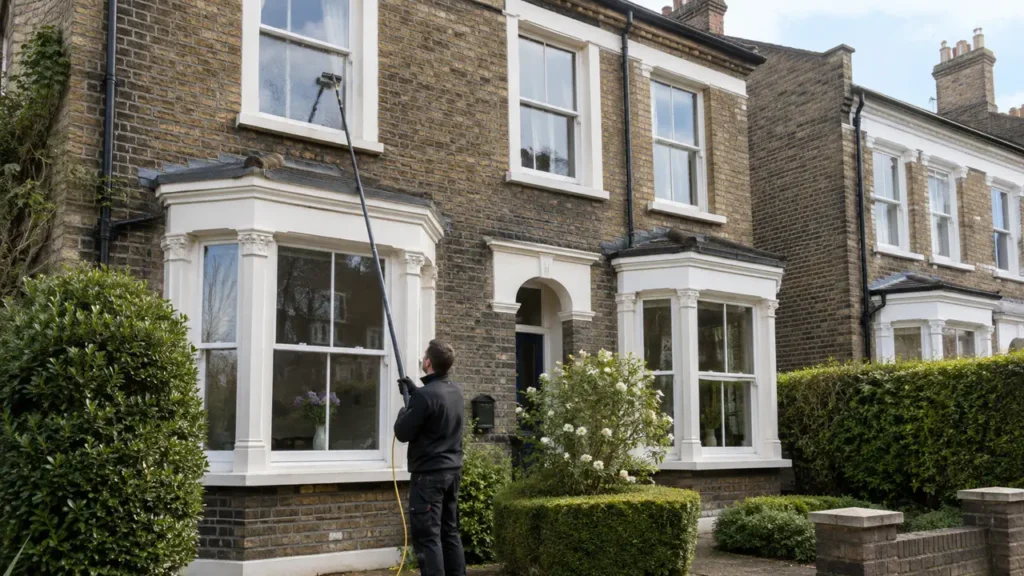
Clean windows can make a noticeable difference to how a property looks from both inside and outside, but there is no single cleaning schedule that suits every London home.
For many residential properties, arranging exterior roughly every 4 to 8 weeks can be a useful starting point, but the right frequency depends on how quickly your windows actually become dirty. A property beside a busy road may need cleaning more frequently than a home in a quieter, sheltered location.
Rather than following an arbitrary schedule, consider your property’s location, surrounding trees, weather exposure, bird activity, building work and how important consistently clean windows are to you.
How Often Should Windows Be Cleaned?
There is no official rule saying residential windows must be cleaned every particular number of weeks.
UK Government facilities-management guidance takes a similar approach for managed buildings, stating that window-cleaning frequencies should be developed according to the needs of the premises.
You can read the UK Government facilities management cleaning guidance.
For a residential property, a practical starting point might be:
- Every 4 to 6 weeks: for properties where consistently clean windows are important or where glass becomes dirty relatively quickly.
- Every 6 to 8 weeks: for many general residential maintenance schedules.
- Every few months: where windows remain relatively clean and the homeowner is comfortable with less frequent maintenance.
- As needed: after building work, unusually dirty weather or another event that leaves significant residue on the glass.
These are practical intervals rather than fixed rules. The best schedule is the one that reflects how quickly your particular property becomes dirty.
If you prefer professional maintenance, Crown Clean London provides in London for properties across the capital and selected surrounding areas.
What Makes Windows Need Cleaning More Often?
Two homes on different London streets can need very different cleaning schedules.
The main factors include:
- Traffic and road pollution
- Nearby trees
- Bird activity
- Building and renovation work
- Dust from nearby construction
- Weather exposure
- Window position and design
- How easily rainwater and dirt collect on the glass
- Whether the property is residential or customer-facing commercial premises
1. Busy Roads Can Make Windows Dirty Faster
Properties close to heavily used London roads may notice dirt returning more quickly than homes on quieter residential streets.
Traffic-related grime, airborne dust and general urban pollution can settle on exterior glass, frames and surrounding surfaces.
If you live beside a busy road, you may find that a shorter interval between cleans gives a more consistent appearance.
This does not necessarily mean every window needs cleaning every few weeks. Check how your own property responds and adjust the schedule accordingly.
2. Nearby Trees Can Affect Frequency
Trees can contribute pollen, leaves, sap, organic debris and bird activity around a property.
A home surrounded by mature trees may therefore develop marks on exterior glass more quickly at certain times of year.
Seasonal changes also matter. Pollen may be more noticeable during spring, while leaves and wet organic material can become more significant during autumn.
If you already use Crown Clean for other seasonal exterior work such as gutter cleaning, it can sometimes be convenient to discuss at the same time.
3. Bird Droppings Should Not Be Left Indefinitely
Bird activity can create isolated marks even when the rest of a window still looks relatively clean.
Properties near roofs, trees, ledges or areas where birds regularly gather may therefore require occasional additional cleaning rather than waiting for the next routine visit.
Cleaning frequency does not always need to be based on the whole window becoming visibly dirty. Particular contamination can justify earlier attention.
4. Building Work Can Leave Windows Dirtier Than Normal
Construction, refurbishment and landscaping work can create unusually high levels of dust around a property.
This can settle on:
- Window glass
- Frames
- Sills
- Doors
- Nearby exterior surfaces
If your property or a neighbouring property is undergoing substantial work, your normal window-cleaning schedule may temporarily need to change.
It may also make sense to wait until the dustiest stage of the work has finished before arranging a more thorough clean.
5. Some Windows Naturally Show Marks More Easily
The direction a window faces, how much direct sunlight it receives and the surrounding building design can all affect how visible dirt appears.
Large panes of glass and windows exposed to strong sunlight can make streaks, dried water marks and surface dirt more noticeable.
Highly visible front-facing windows may therefore be cleaned more frequently than less noticeable glazing at the rear of a property.
Do Windows Need Cleaning More Often in London?
London properties experience a wide range of environments, so there is no single answer.
A home on a quiet residential street in Wembley may have different cleaning needs from a property beside a busy road in central or west London.
Factors such as traffic, building density, mature trees, local construction and the property’s own design are usually more useful than simply saying that every London window should follow the same schedule.
Crown Clean provides exterior cleaning throughout London, allowing the cleaning schedule to be considered according to the individual property.
How Often Should Front Windows Be Cleaned?
Front windows often have the greatest impact on a property’s appearance and may also face roads, pavements and passing traffic.
If the front of your home becomes visibly dirty faster than the rear, there is no requirement for both elevations to receive exactly the same attention at all times.
However, when booking a professional cleaner, cleaning all accessible exterior windows during the same visit may be more practical than arranging separate visits for individual elevations.
How Often Should Windows Be Cleaned on a Customer-Facing Business?
Commercial premises can have a different priority from residential properties because clean glazing forms part of the customer’s first impression.
Shop fronts, offices, restaurants and other customer-facing businesses may therefore choose more frequent than an average residential property.
The appropriate frequency depends on:
- Footfall
- Traffic
- Amount of exterior glass
- Business type
- Visibility of the windows
- How quickly fingerprints and exterior grime become noticeable
The underlying principle remains the same: cleaning frequency should be based on the requirements of the property rather than an arbitrary universal schedule.
Is Regular Better Than Waiting Until Windows Are Very Dirty?
Regular maintenance can make it easier to keep the overall exterior of a property looking consistently cared for.
Waiting until windows are heavily marked is an option, but it means the property spends more time with visibly dirty glazing.
A planned schedule can be useful if:
- You want your home to maintain a consistently clean appearance
- The property becomes dirty at a predictable rate
- You manage a rental or commercial property
- You do not want to remember to arrange cleaning each time
On the other hand, occasional cleaning may be perfectly adequate for a sheltered property where the glass remains clean for long periods.
What Is a Good Schedule for a London Home?
A simple way to find the right schedule is to begin with a reasonable interval and adjust it after seeing the results.
- Start with approximately 6 to 8 weeks.
- Check the windows before the next scheduled clean.
- If they still look clean, extend the interval.
- If they became noticeably dirty much earlier, shorten the interval.
- Adjust seasonally where trees, pollen or weather make a noticeable difference.
This approach gives you a maintenance schedule based on your actual property rather than somebody else’s house.
As one London example, the City of London currently schedules at the Barbican Estate on six-week cycles for many blocks, while some specialist-access windows follow different schedules. This illustrates why access and building requirements can affect cleaning frequency rather than there being one universal interval.
How Are Upper-Floor Windows Cleaned Safely?
becomes more complicated when exterior glass cannot be reached safely from ground level.
The Health and Safety Executive advises that work at height should be avoided where reasonably practicable. For , HSE specifically identifies telescopic water-fed poles and cleaning from inside as examples of methods that can help avoid unnecessary work at height.
You can read the HSE guidance for at height.
The correct access method depends on factors such as:
- Building height
- Window position
- Ground conditions
- Obstacles around the building
- Whether the glass can safely be cleaned from inside
- The equipment required for the particular job
Are Ladders Always Needed for ?
No. HSE specifically says window-cleaning work at height should be avoided where reasonably practicable, which is why ground-based extendable equipment can be useful for many situations.
Where ladders or specialist access equipment are required, the equipment and method should be suitable for the job.
HSE also explains that ladders should not automatically be the first choice simply because a window is above ground level.
This is one advantage of hiring an experienced local window cleaner rather than attempting to reach difficult exterior windows from unsuitable household equipment.
Can You Clean Upper-Floor Windows Yourself?
Windows that can be cleaned safely from inside are different from exterior windows that require someone to climb or overreach.
Avoid leaning dangerously out of windows or using unstable ladders simply to reach exterior glass.
HSE’s wider work-at-height guidance states that work should be properly planned and carried out using appropriate equipment and competent people.
You can also read the HSE cleaning-industry work-at-height guidance.
Does Rain Mean Your Windows Do Not Need Cleaning?
Rain does not automatically clean exterior windows thoroughly.
Rainwater may rinse some loose dust, but it can also interact with existing dirt on the glass, frames and surrounding building surfaces.
The question is therefore not whether it has rained recently, but whether the windows are actually clean afterwards.
Professional is intended to remove accumulated surface dirt rather than simply wet the glass.
Should Window Frames and Sills Be Considered Too?
Glass is the most visible element, but dirty surrounding frames and sills can still affect the overall appearance of the window.
When comparing local window cleaners, ask exactly what is included in the service.
Questions worth asking include:
- Is the service exterior only or interior and exterior?
- Are frames included?
- Are accessible sills cleaned?
- How are upper-floor windows reached?
- Is the service one-off or recurring?
- Are there any windows that cannot be safely accessed?
A clear scope makes it easier to compare services fairly.
What About During Water Restrictions?
Temporary water-use restrictions can affect how householders use hosepipes for exterior cleaning, so current supplier guidance should always be checked when restrictions are in force.
As of August 2026, Thames Water’s current Temporary Use Ban restricts domestic hosepipe use for cleaning windows. Its legal notice also contains an exception where walls and windows are cleaned as a service to customers in the course of a business.
Because temporary restrictions can change, check the current Thames Water legal notice before relying on this information.
How to Choose a Local Window Cleaner in London
If you are searching for a window cleaner near me, consider more than just distance.
Useful questions include:
- Do you regularly cover my postcode?
- Can you clean the type and height of windows on my property?
- What is included in the cleaning service?
- How will difficult windows be accessed safely?
- Do you offer one-off or regular cleaning?
- What frequency would you recommend for this particular property?
A local cleaner who regularly works in your area can help you establish a schedule based on how quickly your windows become dirty rather than forcing every customer onto the same interval.
Across London
Crown Clean London provides professional window and exterior cleaning throughout London and selected surrounding areas.
Coverage includes Wembley, Watford, Borehamwood, Chelsea, Potters Bar, Gerrards Cross and other covered locations.
You can view the complete Crown Clean London service area to check whether your postcode is covered.
Need a Local Window Cleaner in London?
If your windows are becoming visibly dirty or you would prefer a regular cleaning schedule, Crown Clean London can assess the property and advise on an appropriate service.
Send your postcode together with photographs or details of the property, including the approximate number of windows and any areas that may be difficult to access.
Request a quote from Crown Clean London.
Frequently Asked Questions
How often should windows be cleaned?
There is no universal interval. A practical starting point for many homes can be around every 4 to 8 weeks, then adjusted according to traffic, trees, weather exposure and how quickly the windows become visibly dirty.
Is every 6 weeks reasonable?
Yes, a six-week schedule can be a practical maintenance interval for some properties. However, homes in heavily polluted or tree-covered areas may require more frequent cleaning, while sheltered properties may need less.
Do windows need cleaning more often in London?
Some London properties may become dirty relatively quickly because of traffic, construction dust or dense urban surroundings. The property’s specific location is more important than applying one schedule to the whole city.
How often should outside windows be cleaned?
Exterior windows should be cleaned according to how quickly dirt builds up. Start with a regular interval, observe their condition before the next clean and increase or reduce the frequency as necessary.
Does rain clean windows naturally?
Rain may rinse some loose dust but does not necessarily remove accumulated grime from glass, frames and sills. Windows can still benefit from proper cleaning after periods of rain.
Are water-fed poles safer for high windows?
HSE recommends avoiding work at height where reasonably practicable and specifically identifies telescopic water-fed poles as one way window cleaners can work from ground level in suitable situations.
Should I use a ladder to clean my upstairs windows?
Do not use a ladder unless it can be used safely and is appropriate for the task. Avoid overreaching or unstable positioning. Difficult exterior windows are often better handled using appropriate professional equipment.
Does Crown Clean provide near me?
Crown Clean London provides across London and selected surrounding locations. Send your postcode through the contact page to confirm availability.